

5 Steps to Understand Coffee Acidity Levels
Table of Contents
- Step 1: What Coffee Acidity Actually Means
- Step 2: How to Measure Coffee Acidity
- Step 3: Coffee Acidity vs Bitterness: Telling Them Apart
- Step 4: Coffee Flavor Notes by Region and Roast Level
- Step 5: Low-Acid Coffee Brewing Methods for Sensitive Stomachs
- Conclusion: Building Your Acidity Vocabulary
- Frequently Asked Questions
Last Updated: October 8, 2026
Step 1: What Coffee Acidity Actually Means
Coffee acidity is the bright, lively quality that gives a cup its snap, structure, and fruit-like character, and it is not the same thing as the sour, harsh sensation people associate with spoiled or under-extracted coffee. This guide from Everything I Need walks through the five steps to understand coffee acidity levels, starting with the most important distinction in the entire topic: perceived acidity and measured pH are two separate things.
Perceived acidity is a tasting sensation. It shows up as tartness, juiciness, or a sparkling lift on the tongue. Measured pH is a chemistry reading. It tells you how acidic a liquid is on the 0 to 14 pH scale, where 7 is neutral.
Here is the part most guides get wrong. A coffee can read low on the pH scale and still taste smooth, while a coffee with a higher pH can taste sharply sour. The two numbers do not move together, because your palate responds to acids, sugars, and roast compounds together, not to a single reading.
That single insight is the foundation for everything that follows.
Step 2: How to Measure Coffee Acidity
Measuring coffee acidity takes three tools: pH test strips, a digital pH meter, and a buffer solution to calibrate the meter. Strips give you a fast, rough reading. A meter gives you a precise one. The buffer solution keeps the meter honest.
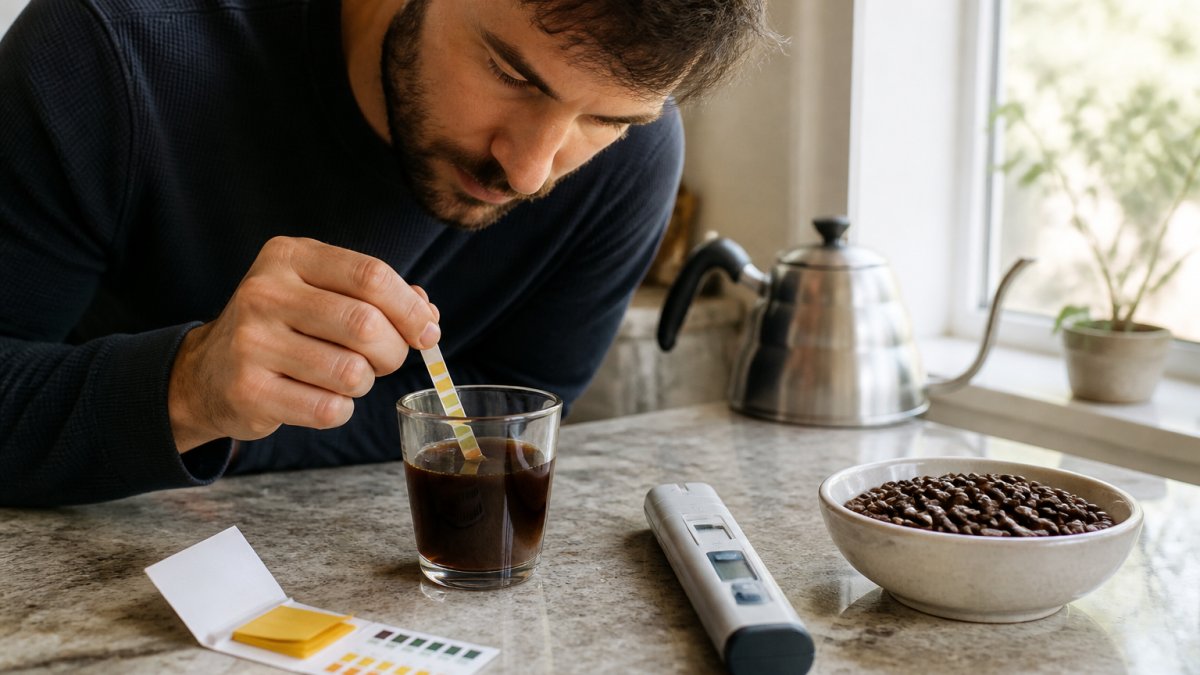
Tools You Need: pH Test Strips, Meters, and Buffer Solutions
- pH test strips: Dip, wait, and match the color to a chart. Cheap and fast, but accurate only to about one pH point.
- Digital pH meter: Gives a decimal reading. Rinse the probe in distilled water between samples.
- Buffer solution: A liquid of known pH used to calibrate the meter before each session.
Brew a fresh sample, let it cool to room temperature, and measure the liquid, not the grounds. For a reliable coffee comparison, keep every variable identical: same grind, same water, same ratio, same extraction time. Change one thing at a time.
What the Numbers Actually Tell You
Most brewed coffee lands somewhere between pH 4.85 and pH 5.10. That is a narrow band, and it is the single most important fact in this section: the difference between a cup you call bright and a cup you call sour is usually a few hundredths of a pH point, not a full point. A reading of 4.90 and a reading of 5.05 can taste dramatically different even though the meter barely moves.
This is why pH alone cannot predict flavor. Your palate responds to the balance of acids, sugars, and roast compounds together. Two coffees at the same pH can taste completely different if one has more caramelized sugar or a darker roast profile. Use the meter to confirm consistency, not to judge quality.
A Repeatable Measurement Routine
- Brew a fresh sample using your normal method.
- Cool it to room temperature, hot samples skew readings and damage probes.
- Calibrate your meter with buffer solution.
- Rinse the probe in distilled water, then submerge it in the sample.
- Wait for the reading to stabilize, record it, and rinse again.
Run this routine three times on the same coffee. If your readings vary by more than 0.1 pH, your technique needs tightening before you trust any comparison.
Step 3: Coffee Acidity vs Bitterness: Telling Them Apart
Coffee acidity and bitterness sit at opposite ends of the tasting experience, and confusing them leads to bad brewing decisions. Acidity registers on the sides of your tongue as tartness or brightness. Bitterness registers at the back of the palate as a dry, ashy, or lingering harshness.
The distinction matters because the fixes are opposite. If a cup tastes sour, you likely under-extracted it, meaning the water did not pull enough from the grounds. Grind finer, raise the water temperature, or extend the brew time. If a cup tastes bitter, you over-extracted it. Grind coarser, lower the temperature, or shorten the time.
A common mistake is adding sugar or milk to mask a fault that a grind adjustment would fix in seconds.
Taste Signal |
Likely Cause |
Adjustment |
|---|---|---|
Sour, thin, sharp |
Under-extraction |
Grind finer, brew longer |
Dry, ashy, harsh |
Over-extraction |
Grind coarser, brew shorter |
Bright, juicy, clean |
Balanced extraction |
No change needed |
Step 4: Coffee Flavor Notes by Region and Roast Level
Coffee flavor notes shift predictably with bean origin and roast level, and learning that map lets you predict what a bag will taste like before you brew it. Altitude, soil, and climate shape the raw bean. The roast level then decides how much of that character survives to the cup.
- East African origins: High-grown beans from Ethiopia and Kenya tend to show vivid fruit and floral notes, with a bright, wine-like acidity.
- Central and South American origins: Colombia and Costa Rica typically deliver balanced cups with red fruit, caramel, and a clean, precise acidity.
- Indonesian and Brazilian origins: Sumatra and Brazil Santos lean earthy, syrupy, and low in perceived acidity, with dark chocolate and nut notes.
Roast level works on top of origin. A light roast preserves the bean's natural acids, so a light Ethiopian tastes sparkling and fruit-forward. A dark roast burns off much of that brightness, trading it for smoke, cocoa, and a rounder, heavier body.
Our single-origin lineup reflects this directly. The Ethiopia Natural pours out blueberry and jasmine, while the Brazil Santos stays smooth and low-acid with hazelnut and brown sugar. Same $23.00 price, two completely different acidity profiles.

Why Origin and Roast Change What You Taste
The mechanism is simpler than most guides admit. Green coffee beans contain organic acids, citric, malic, chlorogenic, and others, that survive roasting in different proportions depending on how dark the roast goes. Light roasts keep more of the bright, fruit-forward acids. Dark roasts break those down and create new bitter compounds instead. That is why a light Ethiopian and a dark Sumatra can start as similar beans and end up tasting like different drinks.
Altitude matters because higher-grown beans mature more slowly, developing more sugars and complex acids. Soil and climate shape which acids dominate. Processing, washed, natural, honey, decides how much fruit character stays attached to the bean. None of these factors work alone. They stack.
A Tasting Vocabulary You Can Actually Use
Most people describe acidity as "sour" or "not sour." That vocabulary is too small to be useful. Here is a repeatable calibration exercise:
- Brew two coffees side by side, one light roast East African, one dark roast Indonesian.
- Taste each and ask: does the acidity feel like lemon, green apple, or stone fruit? Citrus reads sharp and clean. Malic reads crisp and green. Stone fruit reads round and sweet.
- Rate intensity on a simple 1-to-5 scale and write it down.
- Note whether the acidity sits at the front of your tongue or lingers at the back.
Do this three times with different pairs. Within a week, you will stop calling every bright coffee "sour" and start identifying what kind of acidity you are actually tasting. That is the skill this step is really about.
Step 5: Low-Acid Coffee Brewing Methods for Sensitive Stomachs
Low-acid coffee brewing methods reduce the compounds that irritate a sensitive stomach by changing how you brew and which beans you choose. The method matters as much as the bean.
Cold brew leads the list. Steeping grounds in cool water for many hours extracts flavor without the heat that pulls out harsh acids and bitterness. The result is a mellow, smooth cup that many people with digestive sensitivity find far easier to drink. Our Cold Brew Coffee is built exactly for this, with dark chocolate and toasted caramel notes and almost no bite.

Other approaches that help:
- Choose darker roasts, which carry lower perceived acidity than light roasts.
- Pick naturally low-acid origins like Brazil Santos or Sumatra.
- Use a slightly coarser grind and a shorter, gentler brew.
- Avoid stale beans, which taste harsh regardless of origin.
For anyone who wants the full range without the sharpness, our Blonde keeps the acidity lively but gentle, more of a lift than a jolt.

If you are not sure where to start, the simplest move is a controlled comparison. Brew the same method with two different beans, taste them side by side, and note which one sits easier. That single experiment teaches you more than any chart.
Conclusion: Building Your Acidity Vocabulary
The five steps come down to one habit: taste with attention and change one variable at a time. Learn to separate what you measure from what you taste, calibrate your palate the way you calibrate a meter, and acidity stops being a mystery and becomes a tool.
At Everything I Need, we roast small batches to order and use precision thermal mapping to keep bitterness out of the cup, so the acidity you taste is the acidity the origin intended. Our single-origin beans, from Ethiopia to Sumatra, start at $23.00, and ordering is simple enough to fit a busy morning. Get started with Everything I Need and taste the difference a disciplined roast makes in every cup.
Frequently Asked Questions
How do you explain acidity in coffee?
Coffee acidity is the bright, lively quality that makes coffee taste crisp and fruity, similar to the snap of a green apple. It is not the same as sourness or stomach acid. In coffee, acidity contributes to complexity and balance. The pH of coffee typically ranges from 4.85 to 5.10, which is less acidic than orange juice or soda. Perceived acidity depends on roast level, origin, and brewing method.
How to measure acidity of coffee?
You can measure coffee acidity using pH test strips or a digital pH meter. For best results, use a buffer solution to calibrate your meter. Brew a fresh sample, let it cool to room temperature, and dip the strip or probe into the liquid. Compare the reading to the pH scale. Note that perceived acidity may differ from measured pH, so tasting is also important.
Is coffee acidity the same as sourness?
No, coffee acidity and sourness are different. Acidity is a pleasant, bright quality that adds complexity, like the tartness in a ripe berry. Sourness is an unpleasant, sharp taste that often indicates under-extraction or stale beans. A well-brewed coffee balances acidity with sweetness and bitterness. If your coffee tastes sour, try adjusting your grind or brewing time.
Does low-acid coffee taste different from regular coffee?
Low-acid coffee often tastes smoother and less bright than regular coffee. Beans like Brazil Santos have low acidity, offering notes of dark chocolate and hazelnut. Brewing methods like cold brew also reduce perceived acidity. If you are sensitive to acidity, choose low-acid beans and avoid light roasts. You can still enjoy complex flavors without the sharpness.