

How to Make Pour Over Coffee for Beginners
Table of Contents
- What You'll Need Before You Start
- The Pour Over Coffee Ratio That Works Every Time
- Finding the Best Grind Size for Pour Over
- How to Bloom Coffee for Better Extraction
- Step-by-Step: How to Make Pour Over Coffee
- Troubleshooting Pour Over Coffee: Fix Bitter or Sour Cups
- Choosing Beans That Brew Well in a Pour Over
- Conclusion
- Frequently Asked Questions
Last Updated: September 21, 2026
What You'll Need Before You Start
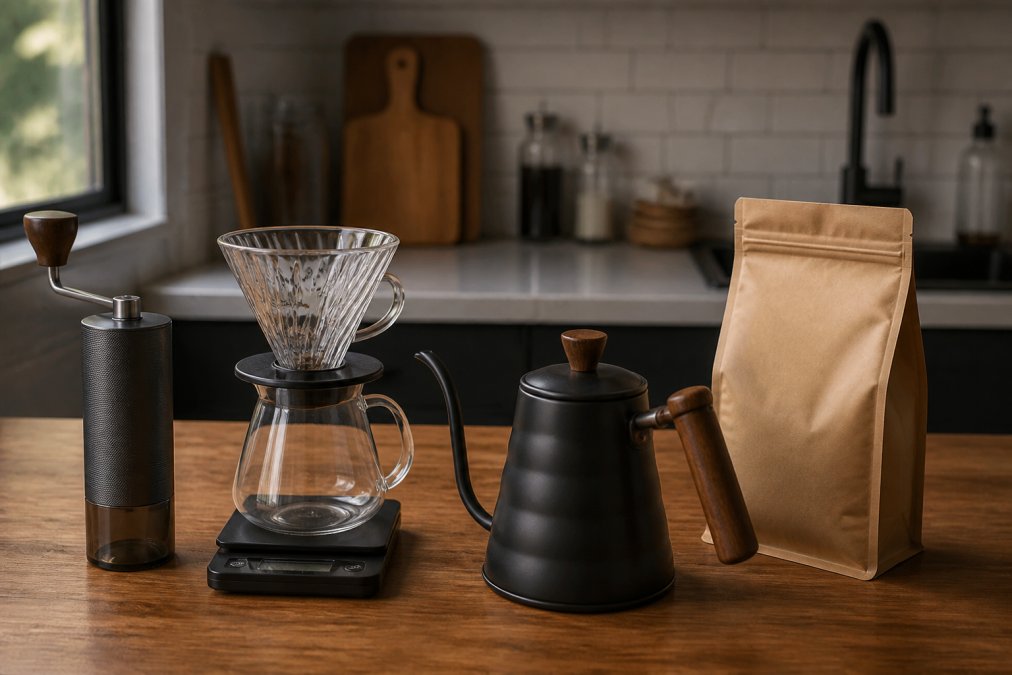
Pour over coffee is a manual brewing method where you pour hot water over coffee grounds in a paper filter, controlling every step by hand. The gear list is shorter than most people expect, and you do not need to buy all of it at once. Here is what actually matters, and where you can save.
The six essentials:
- A pour over cone (V60, Kalita Wave, or Chemex)
- Paper filters that match your cone
- A burr grinder
- A digital scale
- A gooseneck kettle
- Fresh coffee beans
Where to Spend and Where to Save
Beginners often assume they need the most expensive gear to get a good cup. The opposite is closer to the truth. Two items drive most of the difference in taste: the grinder and the beans. Everything else is convenience.
- Grinder, spend here. A burr grinder produces consistent particle size, which is the single biggest variable you control. A hand burr grinder is the lowest-cost way to get consistent grounds. Blade grinders chop unevenly, so some grounds over-extract while others under-extract in the same brew.
- Beans, spend here. Fresh whole beans from a roast-to-order source will outperform stale specialty beans every time. Buy whole bean and grind right before brewing.
- Scale, save here. Any digital scale that reads to 0.1 g works. You do not need a brewing-specific model to hit a 1:16 ratio.
- Kettle, save here. A basic gooseneck kettle gives you the slow, controlled pour that a wide spout cannot. Temperature-control models are convenient but not required, a thermometer and a stovetop kettle get you there.
- Cone, save here. A plastic V60 brews the same cup as a ceramic one. Material affects heat retention, not flavor.
- Filters, save here. Match the filter to your cone. Bleached and unbleached paper both work; unbleached can add a faint paper note if you skip the rinse.
A Note on Water
Water is the ingredient most beginners overlook. If your tap water tastes strongly of chlorine or runs very hard, it will flatten the cup no matter how good your technique is. Filtered water is a cheap upgrade that most guides skip entirely.
The Pour Over Coffee Ratio That Works Every Time
The standard pour over coffee ratio is 1:16, meaning one gram of coffee to sixteen grams of water. For a single 12-ounce cup, that's about 22 grams of coffee and 350 grams of water.
This ratio sits in the sweet spot for most beans. Go stronger at 1:15 for a heavier body. Go lighter at 1:17 if a roast tastes too intense.
Always tare your scale with the empty cone and filter in place first. Then zero it again after adding grounds. This keeps your numbers honest.
Specialty Coffee Association brewing standards
Finding the Best Grind Size for Pour Over
The best grind size for pour over is medium-fine, roughly the texture of table salt. It sits between drip coffee and espresso, and it's the single biggest variable you control.
Grind too coarse and water rushes through, leaving a weak, sour cup. Grind too fine and the bed clogs, producing a bitter, muddy result.
A burr grinder gives you consistent particle size. Blade grinders chop unevenly, which means some grounds over-extract while others under-extract in the same brew.
Start at a medium-fine setting and adjust one notch at a time based on taste. Small changes add up fast.
How to Bloom Coffee for Better Extraction
Blooming is the process of pre-wetting your coffee grounds with a small amount of hot water before the main pour. It releases trapped carbon dioxide so water can extract flavor evenly.
Fresh coffee holds more gas. That gas blocks water from reaching the grounds, which is why a fresh roast needs a proper bloom.
Here's the bloom in practice:
- Pour about twice the coffee's weight in water (roughly 44 grams for 22 grams of coffee)
- Make sure every ground is saturated
- Wait 30 to 45 seconds
- Watch the bed puff up and settle
If your bloom barely bubbles, your beans are likely stale. Fresh beans from a roast-to-order service like Everything I Need will bloom visibly every time.
Step-by-Step: How to Make Pour Over Coffee
Here is the full process, start to finish. Total time runs about 4 minutes once your water is ready.
Step 1: Heat your water. Aim for 195 to 205°F. Just off a boil works well.
Step 2: Rinse the filter. Place the filter in the cone and pour hot water through it. This removes paper taste and preheats your vessel. Dump the rinse water.
Step 3: Add coffee and tare. Add your weighed grounds, then zero the scale.
Step 4: Bloom. Pour 44 grams of water over the grounds. Wait 30 to 45 seconds.
Step 5: First pour. Pour in slow circles from the center outward, reaching about 150 grams total. Avoid the edges.
Step 8: Serve. Swirl the carafe and pour.
Troubleshooting Pour Over Coffee: Fix Bitter or Sour Cups
Troubleshooting pour over coffee comes down to reading two things: the cup and the coffee bed. Taste tells you which direction to move. The bed tells you what actually happened during the pour.
Problem |
Likely Cause |
Fix |
|---|---|---|
Bitter, dry finish |
Water too hot or grind too fine |
Lower temp by 5°F, coarsen grind one notch |
Sour, thin body |
Water too cool or grind too coarse |
Raise temp by 5°F, fine grind one notch |
Weak and watery |
Ratio too light |
Add 1-2 g coffee, keep water the same |
Slow draw-down (past 4:00) |
Grind too fine or too many fines |
Coarsen grind, check grinder burrs |
Fast draw-down (under 2:00) |
Grind too coarse |
Fine grind one notch |
Uneven, weak cup despite good ratio |
Channeling from center pouring |
Pour in wider circles, keep water off the filter wall |
Read the Coffee Bed After the Draw-Down
Most guides stop at taste. The bed gives you a second diagnostic that is faster and more objective.
- Flat, even bed with a slight dome: your pour was even and your grind is in range. Keep this setting.
- Crater in the center, grounds pushed to the walls: you poured too hard down the middle. Water carved a single channel instead of saturating the bed. Slow down and widen your circles.
- Muddy, sludgy bed that stalls: grind is too fine, or you agitated too much during the pour. Coarsen one notch and stop stirring.
- Dry patches on top after the bloom: the bloom pour missed grounds. Pour in a spiral from the center outward until every ground is wet.
- Bed that drains in under two minutes with a hollow, sandy look: grind is too coarse. Fine grind one notch.
Change One Variable at a Time
Choosing Beans That Brew Well in a Pour Over
Not every bean shines in a pour over. Light and medium roasts show their best qualities here because the method highlights acidity, sweetness, and aroma.
Conclusion
Pour over brewing rewards patience, and the learning curve is shorter than it looks. Get your ratio, grind, and pour technique dialed in, and you'll taste the difference in a week.
Frequently Asked Questions
What is the best coffee-to-water ratio for pour over?
Start with a 1:16 ratio, meaning 1 gram of coffee for every 16 grams of water. For a standard 12-ounce cup, that's about 22 grams of coffee and 350 grams of water. If you prefer a stronger cup, tighten the ratio to 1:15. If the cup tastes too intense, loosen it to 1:17. A digital scale makes this far more consistent than measuring by volume, since coffee bean density varies by origin and roast level.
Do I need a gooseneck kettle for pour over coffee?
A gooseneck kettle gives you control over flow rate and direction, which matters when you're trying to saturate the coffee bed evenly. A standard kettle with a wide spout will pour too fast and too wide, causing channeling through the grounds. You can still make pour over coffee with a regular kettle by pouring slowly and carefully, but the results will be less consistent. If you're brewing daily, a gooseneck kettle is the single upgrade that improves your cup the most.
Why does my pour over coffee taste bitter?
Bitterness almost always points to over-extraction. The most common causes are water that's too hot (above 205°F), a grind that's too fine, or a brew time that runs past 4 minutes. Check your grind first: if it feels like table salt, it's too fine for pour over. Then verify your water temperature with a thermometer. Finally, watch your draw-down time. If water sits in the cone longer than 4 minutes, coarsen the grind slightly and try again.
How long should the pour over brewing process take?
A well-executed pour over takes 3 to 4 minutes from the moment you start pouring to the moment the last drop falls through. The bloom alone should take about 30 to 45 seconds. If your total brew time is under 2.5 minutes, your grind is likely too coarse and the coffee will taste weak or sour. If it runs past 4.5 minutes, the grind is too fine and you'll get bitterness. Adjust one variable at a time until you land in that window.