

Is Pour Over Coffee Worth the Effort? A 2026 Review
Table of Contents
- The Pour Over Verdict: Who Should Buy In
- Flavor and Clarity: What You Actually Taste
- Essential Pour Over Coffee Tools You Need
- How to Make Pour Over Coffee for Beginners
- Pour Over Coffee Brew Time: Why Precision Matters
- Cost Per Cup and the Morning Fatigue Factor
- Pour Over vs Drip: Environmental Impact and Effort Scoring
- Conclusion
- Frequently Asked Questions
Last Updated: September 29, 2026
The Pour Over Verdict: Who Should Buy In
Pour over coffee is a manual brewing method in which hot water is poured over a bed of ground coffee in a paper filter, giving the brewer direct control over extraction. Whether it's worth the effort depends on how much you value clarity in the cup versus speed in the morning.
At Everything I Need, we roast small-batch, high-elevation beans specifically for brewers who care about that distinction. If you want a clean cup that shows off tasting notes, pour over delivers. If you want coffee in ninety seconds with zero thinking, it doesn't.
The honest verdict: pour over coffee rewards people who treat brewing as a craft and punishes anyone who treats it as a chore. It demands attention, a few specific tools, and tolerance for a slower routine.
The effort is front-loaded: once you learn the technique, the process becomes muscle memory.
Flavor and Clarity: What You Actually Taste
The biggest advantage of pour over brewing is clarity, which comes from how water moves through the coffee bed. In a paper filter, water passes through the grounds in a controlled, even flow, and the filter traps oils and fine particles that would otherwise end up in your cup.
You taste separation rather than a blended wash: acidity reads as brightness instead of sourness, sweetness comes through as a distinct layer, and aromatics like jasmine or blueberry show up instead of hiding behind body.
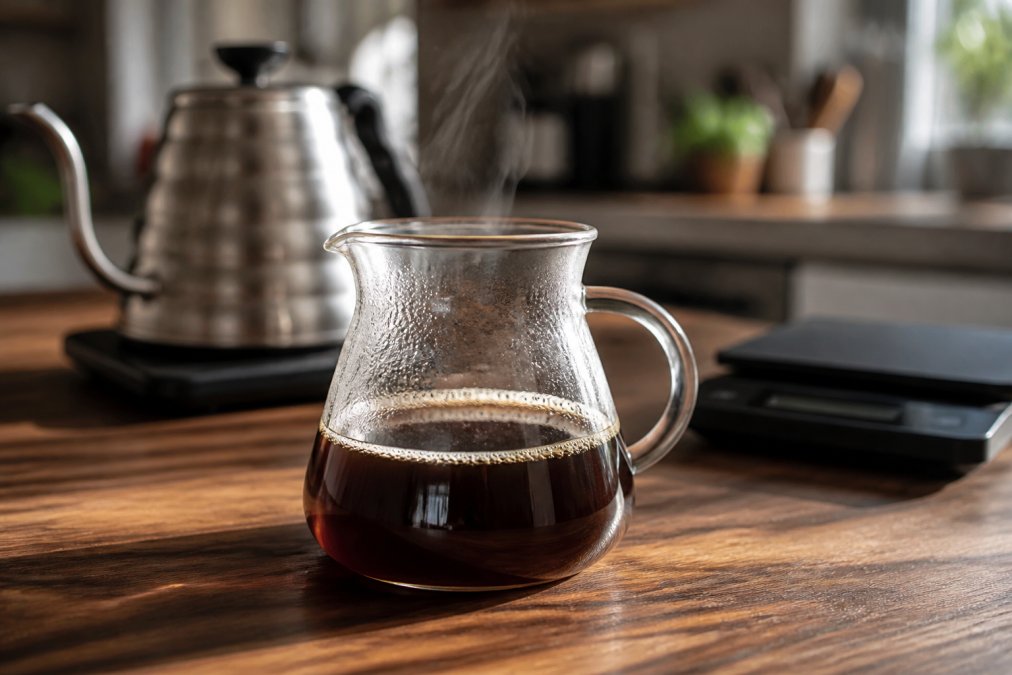
A French press, by contrast, uses immersion and a metal mesh that lets oils through, producing a full-bodied cup where nuance flattens. Neither is better, they're different tools for different cravings.
The bean matters as much as the method. A washed Ethiopian natural brewed as pour over tastes like blueberry and jasmine; the same bean in a drip machine tastes generic. That gap is the entire argument for the method.
Essential Pour Over Coffee Tools You Need
The essential pour over coffee tools are a dripper, a paper filter, a gooseneck kettle, a burr grinder, a scale, and a timer. Skip one and you'll fight the brew instead of guiding it.
Here's what each piece actually does:
- Dripper: A V60, Kalita Wave, or Chemex. The V60 offers maximum control and punishes sloppy pouring; the Kalita Wave is more forgiving; the Chemex brews larger batches with an exceptionally clean cup.
- Paper filters: Match the filter to the dripper. Bleached filters taste neutral; unbleached filters can add a papery note if you skip rinsing.
- Gooseneck kettle: The narrow spout is the whole point. It lets you pour a slow, steady stream instead of dumping water and creating channeling.
- Burr grinder: Blade grinders produce uneven particles, so some grounds over-extract and others under-extract in the same brew. A burr grinder fixes this.
- Scale and timer: You cannot eyeball a brew ratio. Weigh your coffee and water, and time the pour.
Setup cost is the real barrier. A complete beginner kit runs roughly the price of a mid-range drip machine, and the grinder is where you should spend the most.
How to Make Pour Over Coffee for Beginners
The simplest reliable method uses a 1:16 ratio, meaning one gram of coffee to sixteen grams of water. For a single cup, that's about 20 grams of coffee and 320 grams of water.
Total time: about 4 minutes. Difficulty: beginner.
Here's the workflow:
- Heat water to 200°F. Just off boiling, too hot scorches the grounds and adds bitterness.
- Grind 20 grams to a medium-fine consistency. Think table salt. If your brew drains in under two minutes, grind finer.
- Rinse the filter and add grounds. Place the dripper on your scale and zero it out.
- Bloom with 40 grams of water. Saturate the grounds, then wait 30 to 45 seconds as trapped carbon dioxide escapes.
- Pour in slow circles to 320 grams total. Work center outward, keeping the water level steady; total pour time should land around 2:30 to 3:00.
- Let it drain fully, then remove the dripper. Swirl the carafe to mix the layers before serving.
Pour Over Coffee Brew Time: Why Precision Matters
- Under 2:30: The grind is too coarse, or your pour was too fast. The result is weak, sour, and thin.
- Over 3:30: The grind is too fine, or your pour stalled. The result is bitter, dry, and harsh.
- Right in the window: Balanced sweetness, clean acidity, and a finish that lingers pleasantly.
Consistency separates a good cup from a great one: the same beans, ratio, and timing produce the same result every morning.
Cost Per Cup and the Morning Fatigue Factor
Cost per cup is where pour over quietly wins, but morning fatigue is where it quietly loses.
Factor |
Pour Over |
Drip Machine |
Pod Machine |
|---|---|---|---|
Cost per cup |
About $1.30 to $1.55 |
Lower per cup, thinner flavor |
$0.75 to $1.25 per capsule |
Active time |
4 to 5 minutes |
Under 1 minute |
Under 1 minute |
Control over variables |
Full |
Minimal |
None |
Cleaning |
Rinse dripper, discard filter |
Carafe and basket, weekly descale |
Descaling and pod disposal |
Best for |
Flavor-focused brewers |
Speed-focused mornings |
Zero-thought mornings |
- Pre-weigh the night before. Portion your dose into a small jar so the morning only involves grinding and pouring.
- Skip the timer, keep the ratio. With a dialed-in grind, a steady pour to the target weight gets you 90 percent of the result without watching a clock.
- Use a single-pour method. After a 30-second bloom, pour the full volume in one slow spiral. Less precise, far faster.
- Preheat with the kettle, not the tap. A quick rinse of the dripper with hot kettle water does the job in seconds.
- Batch-grind for two days. Grinding the night before costs a little aroma but saves a full step on rushed mornings.
Pour Over vs Drip: Environmental Impact and Effort Scoring
The environmental comparison between pour over and drip is closer than most people assume, and comes down to three variables: paper, energy, and waste.
Effort Category |
Pour Over |
Drip |
What the Score Measures |
|---|---|---|---|
Setup learning curve |
3 |
1 |
Time to brew a reliably good first cup |
Daily active time |
4 |
1 |
Minutes of hands-on attention per brew |
Cleanup |
2 |
3 |
Steps to return the gear to ready state |
Consistency without attention |
4 |
1 |
How much the result drifts when you stop paying attention |
Flavor ceiling |
1 |
3 |
How good the best possible cup can be |
Total effort score |
14 |
9 |
Lower is easier; higher is more demanding |
Conclusion
Whether pour over coffee is worth the effort has a clear answer once you're honest about your mornings. If you want the best possible cup from a single-origin bean and have five minutes to give it, the method pays back in clarity, sweetness, and control no drip machine can match.
Frequently Asked Questions
Is pour over coffee really that much better than automatic drip?
Pour over coffee offers more control over extraction, which means you can adjust grind size, water temperature, and flow rate to highlight specific tasting notes. Automatic drip machines often brew at inconsistent temperatures and lack the agitation control that manual brewing provides. The result is a cleaner cup with more clarity and nuance, especially when using high-quality beans like single-origin offerings from Everything I Need.
What is the disadvantage of pour over coffee?
The main disadvantages are time commitment and the learning curve. A proper pour over takes 3 to 4 minutes of active attention, plus setup and cleanup. You also need essential pour over coffee tools like a gooseneck kettle and scale. Without practice, you risk over-extraction or under-extraction, which leads to bitterness or sourness. It is not a hands-off method.
How long should a proper pour over coffee brew take?
A standard pour over coffee brew time is 2:30 to 3:30 minutes total, including the bloom phase. The bloom, where you pour a small amount of water to release carbon dioxide, should last 30 to 45 seconds. The main pour should take about 2 minutes, followed by a drawdown of 30 to 60 seconds. If your brew finishes faster, your grind is too coarse; if slower, too fine.
Does pour over coffee require special equipment?
You need a few key items: a pour over dripper, paper filters, a gooseneck kettle for controlled pouring, a digital scale, and a burr grinder. A timer helps with consistency. These essential pour over coffee tools are widely available and range from budget-friendly to premium. The investment pays off in control over brew ratio, water temperature, and agitation, all of which affect the final cup.
How does pour over coffee compare to French press in flavor?
Pour over produces a cleaner, lighter-bodied cup with more clarity and separation of flavors. French press uses immersion and a metal filter, which allows oils and fine particles into the cup, creating a fuller body and richer mouthfeel but less brightness. For delicate, nuanced beans like Ethiopia Natural, pour over highlights floral and fruit notes. French press works better for bold, earthy coffees like Sumatra.