

French Press vs AeroPress: Beginner Comparison Guide
Table of Contents
- French Press vs AeroPress: Which Brewer Fits Your Morning?
- Brewing Method Differences: Immersion vs Pressure
- French Press vs AeroPress Flavor Profile
- Best Coffee Grind Size for French Press and AeroPress
- AeroPress Brewing Techniques for Beginners
- Filtration, Sediment, and the Microplastics Question
- Cleanup, Portability, and Capacity Compared
- Common Beginner Mistakes and How to Fix Them
- Environmental Impact and Versatility
- Frequently Asked Questions
Last Updated: October 3, 2026
French Press vs AeroPress: Which Brewer Fits Your Morning?
The French press vs AeroPress decision comes down to one question: do you want a full-bodied, sediment-rich cup from a slow steep, or a fast, clean, pressure-extracted shot? Both are manual brewers that disagree about how coffee should be made.
At Everything I Need, we roast small-batch, high-elevation beans so origin character survives the brew, which makes us picky about the device you pair with them. Below we break down method, flavor, grind, filtration, cleanup, and common mistakes.
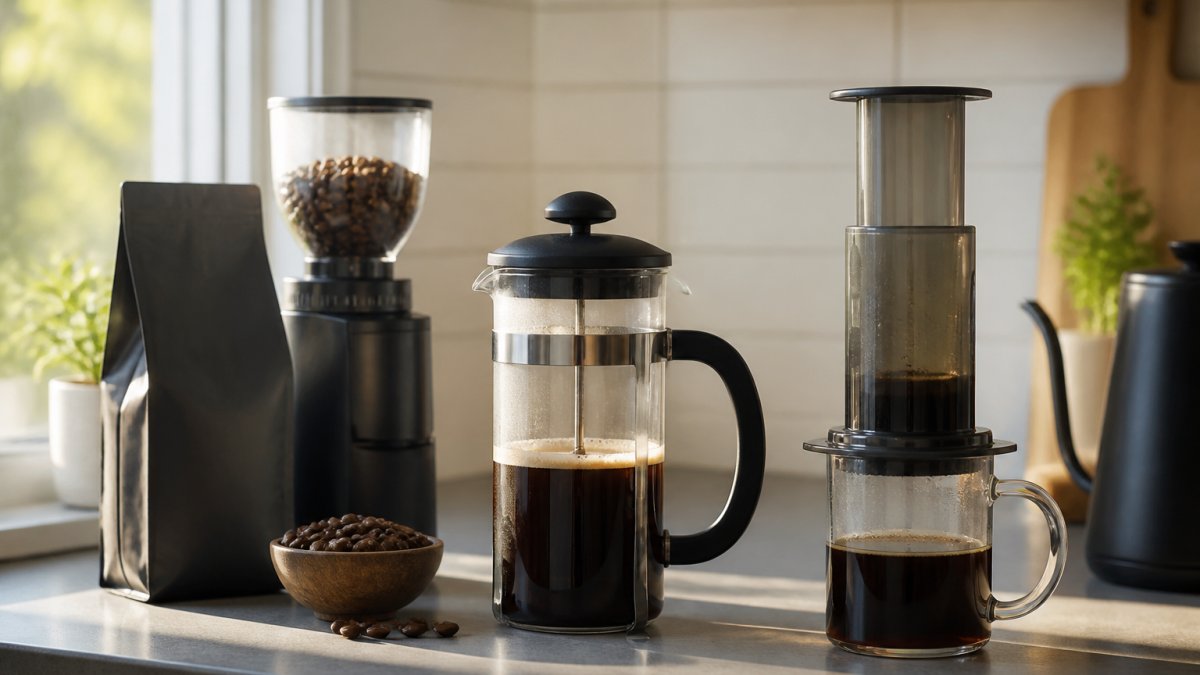
How We Compared These Two Brewers
We judged both brewers on six criteria: brewing method, flavor, grind requirements, filtration and sediment, cleanup and portability, and capacity. We weighted grind compatibility and water temperature heavily, since those cause most beginner disappointment.
Brewing Method Differences: Immersion vs Pressure
The French press is an immersion brewer: add coarse grounds, pour hot water over them, wait about four minutes, then push a metal mesh plunger down. Extraction happens through contact time, not force.
The AeroPress is a pressure-based device: combine grounds and water in a narrow chamber, stir briefly, then press.
That difference shapes everything downstream: body, sediment, cleanup, and how forgiving each device is when you get the grind wrong.
French Press vs AeroPress Flavor Profile
The French press produces a full-bodied, heavier cup.
The AeroPress produces a cleaner cup. Paper filtration traps oils and most fines, so acidity reads brighter and flavor notes separate more clearly.
The trade-off: body is not the same as flavor. The French press gives more texture and mouthfeel; the AeroPress gives more definition. Neither is better, they answer different questions.
Why the Same Bean Tastes Different in Each Brewer
The mechanism explains the gap.
In an AeroPress, the paper filter traps oils and most fines, and the short pressurized push limits heavier compounds. What remains is a thinner liquid that lets acidity and distinct flavor notes read more sharply.
Think of it this way: the French press amplifies texture, the AeroPress amplifies clarity. Brew the same medium roast in both and the French press cup tastes rounder while the AeroPress cup tastes more separated.
How Water Temperature Shifts Each Cup
Temperature is the variable beginners overlook, and it hits these brewers differently.
In a French press, the large water volume and long steep keep brew temperature stable.
In an AeroPress, the narrow chamber and short brew window make temperature more sensitive.
Beginners often blame the brewer when the real issue is water too hot for the grind. Drop the temperature 5°F before changing anything else.
For a dark, chocolatey blend, the French press amplifies what is already there. For a single origin with floral or citrus notes, the AeroPress keeps those notes from blurring. To taste the difference, brew the same Colombia single origin in both devices back to back and note where the caramel and red grape notes land.
Best Coffee Grind Size for French Press and AeroPress
The best coffee grind size for French press is coarse, roughly sea salt texture. The best grind for AeroPress is medium-fine, closer to table salt or drip coffee.
Why the gap? A French press steeps for minutes, so coarse grounds slow extraction and keep sediment manageable.
A burr grinder matters more than the setting number. Blade grinders produce inconsistent particles, and inconsistency is what creates both sour and bitter notes in the same cup.
Why Grind Consistency Matters More Than Grind Setting
Grind consistency means particles are uniform in size, not just correctly sized on average. A coarse grind with a wide spread extracts unevenly: fine dust over-extracts into bitterness while boulders under-extract into sourness.
This is why two people using the same recipe get different results: one has a burr grinder, the other a blade grinder. If you buy one piece of equipment alongside either brewer, make it the burr grinder.
AeroPress Brewing Techniques for Beginners
AeroPress brewing techniques for beginners fall into two families: the standard upright method and the inverted method. Start with the standard method, it is safer, faster, and consistent while you learn.
Standard AeroPress method:
- Insert a paper filter in the cap and rinse it with hot water
- Set the chamber on your mug and add one rounded scoop of medium-fine grounds
- Pour water just off the boil, about 200°F, up to the top line
- Stir gently for 10 seconds to saturate all grounds
- Wait 60 to 90 seconds
- Press down slowly over 20 to 30 seconds
The inverted method flips the device so the cap sits on top during the steep, preventing premature dripping.
Filtration, Sediment, and the Microplastics Question
Filtration is the clearest dividing line. The French press uses a metal mesh filter that traps coarse particles but passes oils and fine sediment into your cup.
Sediment is a preference, not a defect. Some drinkers want the texture; others find the last sip of a French press gritty and unpleasant.
The microplastics question circulates widely and gets oversimplified. Research on plastic particles in coffee brewing has focused on plastic and nylon components contacting hot water.
Cleanup, Portability, and Capacity Compared
Cleanup favors the AeroPress: press the grounds and filter into the trash as one puck, rinse the chamber, done in under a minute.
Portability also favors the AeroPress: compact, lightweight, and impact-resistant. A glass French press is heavy and breakable, though stainless steel models hold up better.
Serving capacity favors the French press. A standard 8-cup carafe brews enough for two to three people in one batch. The AeroPress makes one concentrated cup per press, so serving a household means repeating the process.
Factor |
French Press |
AeroPress |
|---|---|---|
Brewing method |
Immersion, 4-minute steep |
Pressure, ~2 minutes |
Flavor profile |
Full-bodied, oily, rich |
Clean, bright, defined |
Grind size |
Coarse, sea salt texture |
Medium-fine, table salt texture |
Filter type |
Metal mesh, some sediment |
Paper, minimal sediment |
Cleanup time |
2-3 minutes |
Under 1 minute |
Portability |
Low, glass is fragile |
High, compact and durable |
Capacity |
2-3 servings per batch |
1 serving per press |
Best for |
Slow mornings, shared coffee |
Fast mornings, solo drinkers |
One Grinder, Two Brewers: A Beginner Workflow
Pick a reference setting and adjust in small steps. Start at your grinder's medium setting, brew the AeroPress first, and note whether the cup tastes sour (grind finer) or harsh (grind coarser).
A burr grinder makes this workable because the particle spread is narrow. A blade grinder's wide spread over-extracts fines and under-extracts boulders, so the same setting can taste bitter and sour in one cup.
What Actually Fits Your Counter and Your Mornings
Capacity is not just about volume. A French press rewards a slow morning: brew for two, set the carafe down, pour a second cup without re-brewing.
One cup before work: the AeroPress wins on cleanup and speed. Two or three cups kept hot in a carafe: the French press wins on capacity and holding time.
Common Beginner Mistakes and How to Fix Them
Bitterness in a French press almost always traces to a grind that is too fine, water that is too hot, or a steep that runs too long. Fix the grind first, it has the largest effect.
Sourness in an AeroPress usually means under-extraction. Grind finer, stir longer, or extend the steep by 15 seconds.
Here are the fixes worth memorizing:
Problem |
Likely Cause |
Fix |
|---|---|---|
French press tastes bitter |
Grind too fine, steep too long |
Coarsen grind, cut steep to 4 minutes |
French press tastes weak |
Grind too coarse, low brew ratio |
Grind finer, add more coffee |
AeroPress tastes sour |
Under-extracted |
Grind finer, stir longer |
AeroPress tastes harsh |
Water too hot |
Let water cool to about 200°F |
Both taste muddy |
Blade grinder inconsistency |
Switch to a burr grinder |
Water just off the boil, around 200°F, extracts evenly without scorching. Boiling water poured directly onto fine grounds pushes bitterness forward, especially in the AeroPress where the bed is narrow and hot.
Environmental Impact and Versatility
Environmental impact tilts toward the AeroPress on paper waste and the French press on durability.
Versatility favors the AeroPress: brew a standard cup, a concentrated shot for milk drinks, or a cold brew concentrate with a longer steep.
Grind compatibility is where the AeroPress wins outright. It tolerates a wider range of grind sizes than the French press, which turns gritty fast when the grind drifts fine.
Whichever brewer you choose, the beans decide most of the outcome. Our Six Bean Blend is built for both methods, with dark chocolate and toasted cedar notes that hold up under immersion and stay defined under pressure. For a brighter cup, our Colombia single origin shows caramel and red grape notes the AeroPress renders with particular clarity.

Six Bean Blend
Buy the brewer that matches your mornings. Buy the coffee that deserves it.
Most beginners buy a brewer, then fight inconsistent results because the beans were never fresh. Order the House Blend or the Breakfast Blend and give either brewer a fair test.


Frequently Asked Questions
Should I get an AeroPress or French press for my first brewer?
If you drink one or two cups at a time and want a clean cup with minimal sediment, the AeroPress is easier to learn and clean. If you regularly brew for two or more people and prefer a full-bodied, oil-rich cup, a French press serves more at once and requires less hands-on attention during brewing. Beginners who value speed and tidiness tend to reach for the AeroPress; those who want a slower, ritualistic steep and a richer mouthfeel often prefer the French press.
Is AeroPress coffee healthier than French press coffee?
Both brewers produce coffee without added calories or additives, so the health difference comes down to filtration. AeroPress uses a paper microfilter that traps most coffee oils and sediment, while a French press metal mesh filter lets oils and fine particles through. Some drinkers sensitive to LDL cholesterol prefer paper-filtered coffee for this reason. Neither method is inherently unhealthy; the choice depends on whether you want a cleaner cup or a fuller-bodied one.
What are the downsides of using a French press?
A French press leaves sediment in the cup because the metal mesh filter does not catch fine particles. It also requires a coarser grind, and if your grind is too fine, the plunger becomes hard to press and the coffee turns bitter from over-extraction. Cleanup takes longer than an AeroPress because you need to scoop out the grounds and rinse the mesh thoroughly. Finally, a glass carafe can break if dropped, so it is less travel-friendly.
Which brewer is easier to clean: French press or AeroPress?
The AeroPress wins on cleanup. You press the grounds into the trash, rinse the plunger and chamber, and you are done in under a minute. A French press requires scooping wet grounds from the bottom of the carafe, disassembling the plunger and mesh filter, and rinsing each part to prevent oil buildup. If you brew before work and want the fastest possible routine, the AeroPress saves several minutes every morning.
Does AeroPress coffee contain microplastics?
The AeroPress itself is made from BPA-free plastic, and its paper microfilter traps most particles before they reach your cup. Research on microplastics in coffee is still developing, and the levels found in brewed coffee are generally very low. If microplastic exposure is a concern, using paper filters with either brewer reduces the amount of sediment and oil that passes into your cup. The French press metal mesh filter allows more particles through, but those particles are coffee grounds and oils, not plastic.