

High Elevation Coffee Benefits: What Makes It Better
Table of Contents
- What Is High Elevation Coffee and Why Does It Matter?
- How Coffee Bean Density and Flavor Connect at High Altitudes
- What Makes the Best Artisan Coffee Stand Out
- Frequently Asked Questions
Last Updated: September 10, 2026
What Is High Elevation Coffee and Why Does It Matter?
High elevation coffee is grown where cooler air and slower cherry maturation concentrate sugars and acids, producing denser beans and more complex flavor. Most specialty roasters treat roughly 1,200 meters and above as the threshold (peer-reviewed research).
Altitude matters because it slows the plant down: cooler temperatures extend the cherry's maturation, giving flavor precursors more time to develop (PubMed). The result is a denser bean with more pronounced acidity and a structured sweetness.
Below: what high elevation coffee benefits actually are, how bean density and flavor connect, and what separates the best artisan coffee from commodity beans.
How Coffee Bean Density and Flavor Connect at High Altitudes
Dense beans hold more dissolved solids and roast more evenly, which is why bean density and flavor are so tightly linked at high altitudes (peer-reviewed research). Slower maturation concentrates sugars and acids, and the denser cell structure survives roasting with more compounds intact.
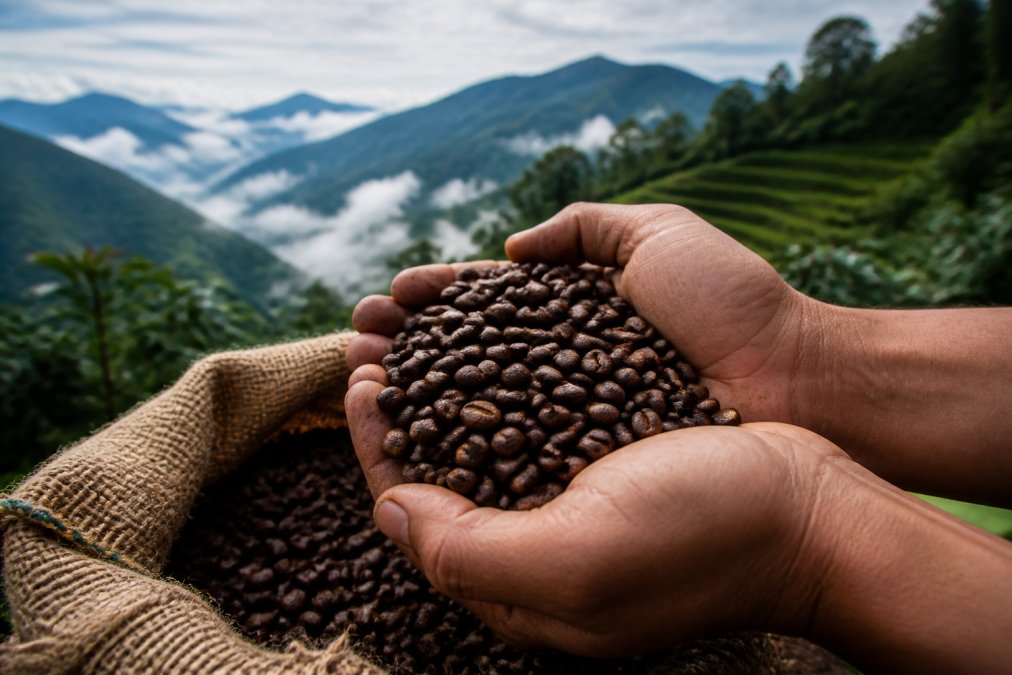
Freshly roasted coffee beans
Key factors:
- Maturation rate: Cooler air lengthens the harvest cycle, so cherries ripen gradually.
- Sugar development: More time on the branch means more sugar inside the fruit.
- Acidity and aroma: Higher elevations push brighter acidity and a layered aroma.
- Bean hardness: Dense beans resist heat differently, changing roast and extraction.
A single-origin label does not guarantee this. Altitude, variety, and processing all shape the cup, and a low-grown bean with a fancy label still tastes thin.
What Makes the Best Artisan Coffee Stand Out
The best artisan coffee comes down to sourcing discipline and roast control, not packaging. Beans grown at elevation give a roaster more to work with, but the roasting process decides whether that potential survives to the cup.
Everything I Need builds its lineup around this idea. The Asian Plateau Blend draws from Sumatra, Vietnam, and the highlands of Yunnan, while the Sumatra comes from smallholder farms in Aceh at 1,100 to 1,600 meters. The Papua New Guinea and Peru follow the same pattern: shade-grown, high-elevation estates, roasted to order.


Precision thermal mapping keeps bitterness out by tracking temperature through the roast, avoiding the scorching that turns a promising bean ashy.
What to Look For |
Why It Matters |
|---|---|
Stated elevation range |
Confirms genuine high-elevation sourcing |
Roast-to-order timing |
Fresher beans with intact aroma |
Processing method |
Shapes body, acidity, and sweetness |
Named estate or cooperative |
Traceable, verifiable origin |
Frequently Asked Questions
Why is high altitude coffee better?
High elevation coffee benefits from cooler temperatures that slow cherry maturation, allowing sugars and flavor precursors to develop fully. This produces denser beans with more complexity, brighter acidity, and richer aroma. The altitude threshold typically starts around 1,200 meters, where Arabica varieties thrive and develop the characteristics that define specialty coffee.
Does elevation affect the caffeine content in coffee?
Elevation has a modest effect on caffeine content. High-elevation Arabica beans generally contain slightly less caffeine than lower-grown Robusta, but the difference within Arabica varieties is small. The bigger influence on your cup is bean density and sugar development, which shape flavor more than caffeine level does.
How do I identify high-elevation coffee on a label?
Look for the elevation range printed on the bag, usually listed in meters. Specialty roasters often include the growing region and farm name. Beans from Sumatra, Papua New Guinea, Peru, and the Asian Plateau typically carry elevations between 1,100 and 1,600 meters, signaling the density and flavor profile you want.