

How to Identify First Crack in Coffee Roasting
Table of Contents
- What First Crack Is and Why It Happens
- What Does First Crack Sound Like?
- First Crack Coffee Roasting Temperature
- How Long Does First Crack Last?
- First Crack vs Second Crack
- Cross-Checking Sound with Visual and Smell Cues
- Troubleshooting Difficult-to-Hear Cracks
- Building a Roast Log for Repeatability
- Frequently Asked Questions
Last Updated: October 15, 2026
What First Crack Is and Why It Happens
First crack is the moment green coffee beans audibly split open during roasting as built-up steam and carbon dioxide force their way out of the bean's cellular structure. It marks the point where a roast shifts from drying and browning into true flavor development.
At Everything I Need, we treat this moment as the single most important signal in the entire roast. Miss it by thirty seconds and you can flatten the sweetness we work hard to protect.
Here's why it happens. Green beans hold moisture inside tight cell walls. As bean temperature climbs, that water turns to vapor and internal pressure builds. When the pressure wins, the structure gives way. That release is the crack.
Three things drive the timing:
- Moisture content of the green coffee
- Batch size and charge weight
- Heat transfer from your roaster
A dense, high-elevation bean holds more water and takes longer to reach crack onset. A small batch in a drum roaster gets there faster than a large one.
What Does First Crack Sound Like?
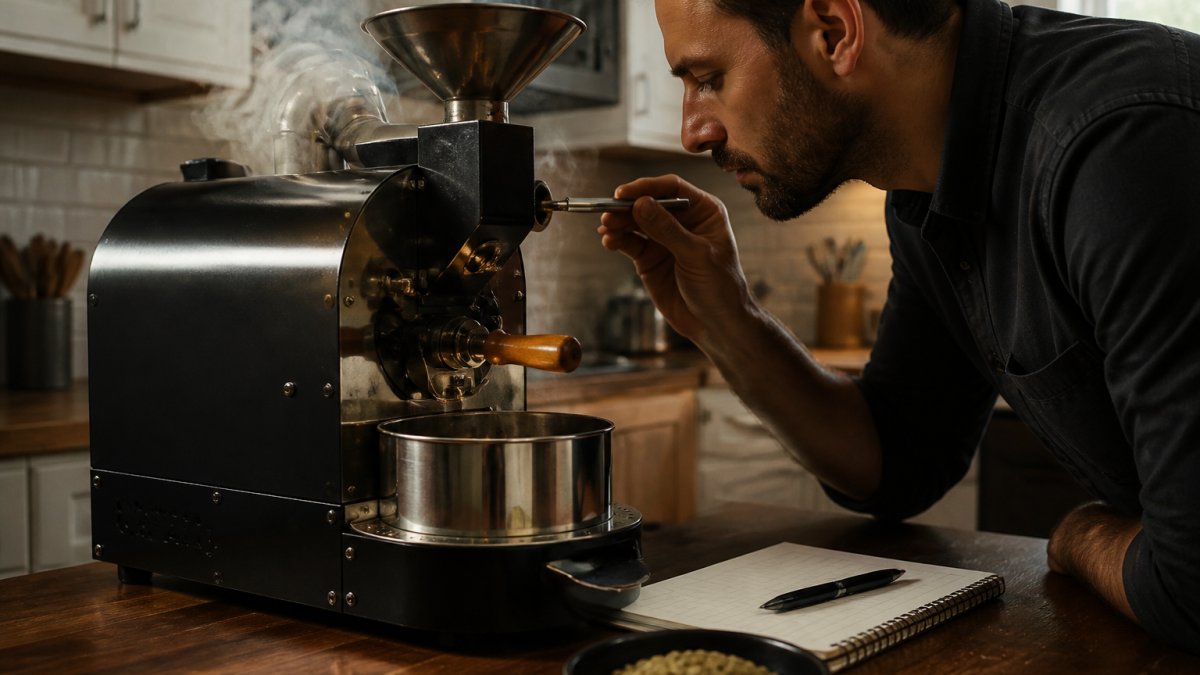
First crack sounds like dry popcorn popping or the snap of a small twig breaking, arriving as a scattered series of individual pops that build into a rolling rhythm. It is sharp, distinct, and irregular, not a smooth or continuous noise.
Listen for the pattern, not just the volume. Early pops come one at a time with gaps between them. As the roast progresses, the gaps close and the sound thickens into a steady crackle.
A few listening tips that help in a noisy space:
- Cup your hand near the roaster's exhaust or tryer opening to funnel sound toward your ear
- Kill background noise: fans, music, and conversation all mask the onset
- Use a metal or cardboard listening tube if your roaster runs loud
- Note the exact time of the first pop you hear, not when cracking becomes constant
That first isolated pop is your crack onset. Everything downstream in your roast plan keys off it.
First Crack Coffee Roasting Temperature
First crack coffee roasting temperature typically falls between 390°F and 410°F on a bean probe, though the exact reading depends on where and how you measure it. That range is a starting reference, not a fixed target.
Why Displayed Temperatures Vary
The number on your roaster's display is not a universal truth. It is one sensor's reading at one location in one machine. Four factors shift it:
- Probe placement. A probe sitting in the airflow can read 30 to 50 degrees higher than one buried in the bean mass. A probe touching the drum wall reads differently again.
- Roaster design. Drum roasters, fluid-bed roasters, and sample roasters all move heat differently, so the same bean can crack at very different displayed temperatures.
- Batch size. A small batch heats faster and can show a higher probe reading at crack onset than a large batch in the same machine.
- Calibration and sensor type. Thermocouples drift over time. Two identical roasters can read 10 to 20 degrees apart without either being broken.
Two roasters can hit first crack at the same real moment and show very different numbers. That is normal, not a fault.
How to Establish Your Own Baseline
Instead of chasing a textbook number, build a personal reference:
- Log the temperature your probe reads at crack onset for every batch.
- Repeat with the same green coffee and batch size at least three times.
- Average the readings to get your baseline for that setup.
- Recalibrate whenever you change batch size, green coffee, or roaster.
Once you have a baseline, that number becomes your sanity check. If your probe says 400°F and you hear nothing, wait. If you hear cracking at 375°F, believe the sound.
Using Temperature as a Cross-Check, Not a Trigger
Temperature is most useful when it confirms what your ears and eyes already suspect:
- Use 390-410°F as a rough sanity check, not a trigger
- Trust your ear first, your probe second
- Watch for rate-of-rise changes near crack onset, which often signal the bean is about to pop
- Compare bean temperature and environment temperature to understand how your roaster moves heat
Bean and Equipment Variation
Even with a solid baseline, first crack timing and sound can shift with the coffee itself:
- Dense, high-elevation beans hold more moisture and take longer to reach crack onset
- Natural or honey-processed beans can crack earlier and more quietly than washed beans
- Older or drier green coffee reaches crack faster and with less audible pop
- Larger batch sizes in the same roaster tend to crack later and more loudly than small ones
Log these variables alongside your temperature readings so you can see how each one moves your baseline over time.
How Long Does First Crack Last?
First crack usually lasts between one and two minutes from the first isolated pop to the point where cracking becomes sparse and fades out. Total roast duration from charge to crack onset commonly runs eight to twelve minutes, depending on roaster type and batch size.
The window matters because development time, the span between crack onset and when you drop the roast, is where sweetness and body are built. Too short and the roast tastes grassy and underdeveloped. Too long and you burn off the sugars you were trying to keep.
A simple way to think about it:
Roast Stage |
What You Hear |
What It Means |
|---|---|---|
Approach |
Rolling, no pops |
Drying and browning phase |
Crack onset |
First isolated pops |
Development begins; start your clock |
Active crack |
Steady, rolling crackle |
Full development underway |
Tail-off |
Pops thin out and stop |
Development window closing |
Roasters who want a brighter, fruit-forward cup often drop shortly after crack ends. Those chasing deeper sweetness and body let development run longer, staying well clear of second crack.
First Crack vs Second Crack
First crack vs second crack comes down to what's breaking. First crack is water vapor and carbon dioxide escaping the bean. Second crack is the bean's cellular structure itself fracturing as oils and fibers give way under continued heat.
The sounds differ too. First crack pops are louder, lower, and more spaced out. Second crack is a faster, higher-pitched, more continuous snap, closer to the sound of rice cereal in milk. It is quieter per pop but more relentless.
What each one tells you:
- First crack: development has begun; you control the roast from here
- Second crack: you are entering dark roast territory; oils are surfacing and origin character is fading fast
For most specialty roasts, you want to drop before second crack starts. Second crack is a boundary, not a destination.
Cross-Checking Sound with Visual and Smell Cues
Sound alone can fail you, so cross-check with your eyes and nose. The three cues together give you a far more reliable read than any one of them.
Visual cues at first crack:
- Beans visibly expand and lose their smooth surface
- Color shifts from tan toward light brown
- Chaff starts releasing and collecting in the chaff tray
- A light sheen may appear as surface oils begin to move
Smell cues:
- Before crack: grassy, hay-like, bready
- At crack: a sweeter, toasted aroma replaces the grassy note
- Past development: aroma deepens toward cocoa and caramel
If you hear nothing but the beans have clearly expanded and the grassy smell has turned sweet and toasty, you are likely at or just past crack onset. Trust the combination.
Specialty Coffee Association guidance on roasting and cupping standards
Troubleshooting Difficult-to-Hear Cracks
Quiet cracks usually come down to three causes: a loud roaster, a small batch, or a probe and ear mismatch. Fix the environment before you change your roast plan.
Try these in order:
- Move closer to the exhaust or tryer. Many roasters vent a lot of the crack sound away from where you stand.
- Use a listening tube. A short metal or cardboard tube aimed at the bean mass amplifies the pops.
- Increase batch size slightly. Very small batches crack quietly and fast, giving you almost no window.
- Reduce airflow at the end of the roast. High airflow carries sound and heat away and can mute the crack.
- Watch for the visual tells. Expansion, color shift, and chaff release all confirm what your ears missed.
If your roaster is simply loud, lean on temperature and visuals as your primary cues and treat sound as a bonus confirmation.
Building a Roast Log for Repeatability
Repeatability is the whole point. A roast log turns a lucky batch into a repeatable one. Without it, you are guessing every time you fire up the roaster.
Log these fields for every batch:
- Green coffee origin and lot
- Batch size and charge weight
- Charge temperature
- Time to first crack onset
- Bean temperature at crack onset
- Development time (crack onset to drop)
- Total roast duration
- Drop temperature
- Roast degree and weight loss
- Tasting notes from the cupping table
Software like Artisan roast logging software can capture bean temperature, environment temperature, and rate of rise curves automatically, which makes spotting drift far easier than a paper log.
The workflow that works best: roast, log, cup, then adjust one variable at a time. Change only the development time on your next batch and compare. That's how you dial in the sweet, cacao-forward profile.
For a deeper grounding in how roast degree shapes flavor, the USDA coffee and caffeine reference material is a useful starting point for understanding what ends up in the cup.
Getting first crack right is the difference between a roast that tastes flat and one that lands with the complex sweetness you're after. If dialing in your own roast sounds like more work than it's worth, Everything I Need does it for you.
Frequently Asked Questions
What does first crack sound like?
First crack sounds like a series of sharp pops or snaps, similar to popcorn popping but softer and more rapid. Each crack is a distinct sound caused by moisture and gases escaping as the bean expands. Listen for a rhythm of individual pops rather than a continuous roar. In a drum roaster, the sound may be muffled, so adjust your position or use a stethoscope. This audible cue is the most reliable signal that first crack has begun.
At what temperature does first crack usually happen?
First crack typically occurs when the bean temperature reaches between 390°F and 410°F. However, the exact temperature depends on the bean's origin, density, moisture content, and your roaster's probe placement. Environment temperature may read higher. Use this range as a starting point, but always rely on sound and smell as primary cues. If your probe reads 390°F and you hear no cracks, trust your ears and wait.
How long does first crack last?
First crack usually lasts between 1 and 2 minutes, though this varies with batch size, bean density, and heat application. A 1-pound batch might crack for 90 seconds, while a 5-pound batch could take longer. The end of first crack is marked by a significant drop in popping sounds. For a medium roast, development time after first crack often ranges from 15% to 25% of total roast time. Listen for the final few pops to know when it's ending.
How can you tell first crack from second crack?
First crack sounds like distinct, low-pitched pops with pauses between them. Second crack is faster, higher-pitched, and sounds like a continuous sizzle or snap, often accompanied by a darker, oilier bean surface and a sharper, smokier aroma. First crack happens around 390-410°F, while second crack typically starts around 435-450°F. If you miss first crack, you'll notice second crack as a rapid crackling that quickly leads to dark roast flavors.