

How to Identify Fruity Notes in High Elevation Coffee
Table of Contents
- Why High Elevation Coffee Tastes Fruity
- High Elevation vs Low Elevation Flavor Profiles
- Using a Coffee Flavor Wheel Guide to Name What You Taste
- How to Perform a Coffee Cupping at Home
- Separating Fruit Notes from Acidity, Fermentation, and Roast
- Best Brewing Methods for Fruity Coffee
- When Elevation Claims Fall Short: Limits and Variability
- Frequently Asked Questions
Last Updated: October 6, 2026
Why High Elevation Coffee Tastes Fruity
High elevation coffee is coffee grown at higher altitudes, where cooler air slows cherry maturation and pushes more sugar and flavor into the bean.
The link between altitude and flavor is well documented. According to Specialty Coffee Association research on origin and quality, higher-grown beans often show more acidity and complexity.
But most guides stop at the claim. They tell you high coffee is fruity and leave it there.
Below, we show you exactly how to taste those fruit notes, name them, and tell them apart from acidity, fermentation, and roast.
Cooler Temperatures and Slower Cherry Maturation
Cherries ripen slowly at altitude. Cool nights and mild days stretch the growing season by weeks.
That extra time matters. The plant keeps pumping sugars into the fruit, and those sugars develop into the compounds we read as fruit flavor. Faster ripening lower down gives the bean less time to build that depth.
Bean Density and Flavor Development
High-grown beans are denser. Dense beans hold up better in the roaster and often carry more concentrated flavor.
Density also signals quality. Tasters and buyers use it as a rough marker of a well-developed bean. Denser beans tend to roast more evenly, which protects the delicate fruit notes instead of burning them off.
High Elevation vs Low Elevation Flavor Profiles
High elevation coffee tends to taste bright, sweet, and layered. Lower-grown coffee leans heavier, flatter, and more toward nuts and cocoa.
Here is the practical split:
| Trait | High Elevation | Low Elevation |
|---|---|---|
| Acidity | Bright, lively | Soft, muted |
| Fruit notes | Citrus, berry, stone fruit | Mild, subtle |
| Body | Lighter but complex | Heavier, simpler |
| Sweetness | Clear and layered | Flat |
Altitude is not the only factor. Processing, variety, and roast all shape the cup. But elevation sets the ceiling on how much fruit a bean can show.
Using a Coffee Flavor Wheel Guide to Name What You Taste
A coffee flavor wheel guide is a tool that organizes tasting notes into families so you can put a name to what you taste.
The Coffee Quality Institute's flavor resources organize these families for professional cuppers. Home tasters can use the same logic.
Start broad: is it fruity, nutty, floral, or spicy? Then narrow. If fruity, is it citrus, berry, or stone fruit? Keep narrowing until the note feels right.
Fruit Families: Citrus, Berry, Stone Fruit, Tropical, Dried
Most fruit notes fall into five families:
- Citrus: lemon, orange, grapefruit, bergamot
- Berry: blueberry, strawberry, raspberry, blackcurrant
- Stone fruit: peach, apricot, plum, nectarine
- Tropical: mango, pineapple, passionfruit
- Dried: raisin, prune, date, fig
Knowing the family makes your notes sharper. "Fruity" is vague. "Blueberry" is useful.
Separating Fruit Aroma from Acidity
This is where most tasters get stuck. Acidity is a sensation, the mouth-watering tingle on the sides of your tongue. Fruit is an aroma and taste you can name.
A quick test: hold your nose and sip. If the tingle remains but the fruit disappears, you were tasting acidity, not fruit.
You can have high acidity with no fruit. You can have fruit with low acidity. They often travel together, but they are separate signals.
Separating Fruit from Fermentation and Roast
Fermentation is another trap. A natural process can push big, jammy, winey flavors. Those read as fruit, but they come from the processing method, not the bean alone. If the note feels boozy or vinegar-like, it is fermentation, not fruit.
Roast changes everything too. A light roast keeps fruit bright and clear. A dark roast burns those notes into smoke and bitter cocoa.
- Acidity: the tingle, not the flavor
- Fruit: the aroma and taste, named
- Fermentation: jammy, winey, boozy depth
- Roast: light keeps fruit, dark hides it
A Naming Routine You Can Repeat
Use this sequence every time you cup:
- Name the family (citrus, berry, stone, tropical, dried).
- Name the specific fruit if you can.
- Note whether it is aroma, taste, or both.
- Note whether it fades or grows as the cup cools.
That last step separates true fruit from roast or ferment character. Real fruit notes usually shift and develop as coffee cools. Roast and ferment notes tend to stay flat or intensify in one direction.
Our Ethiopia Natural shows blueberry and strawberry jam with jasmine on top, a clear berry-family example. Our Kenya leans citrus and blackcurrant, a citrus-family example. Cupping them side by side is a fast way to practice the naming routine.


How to Perform a Coffee Cupping at Home
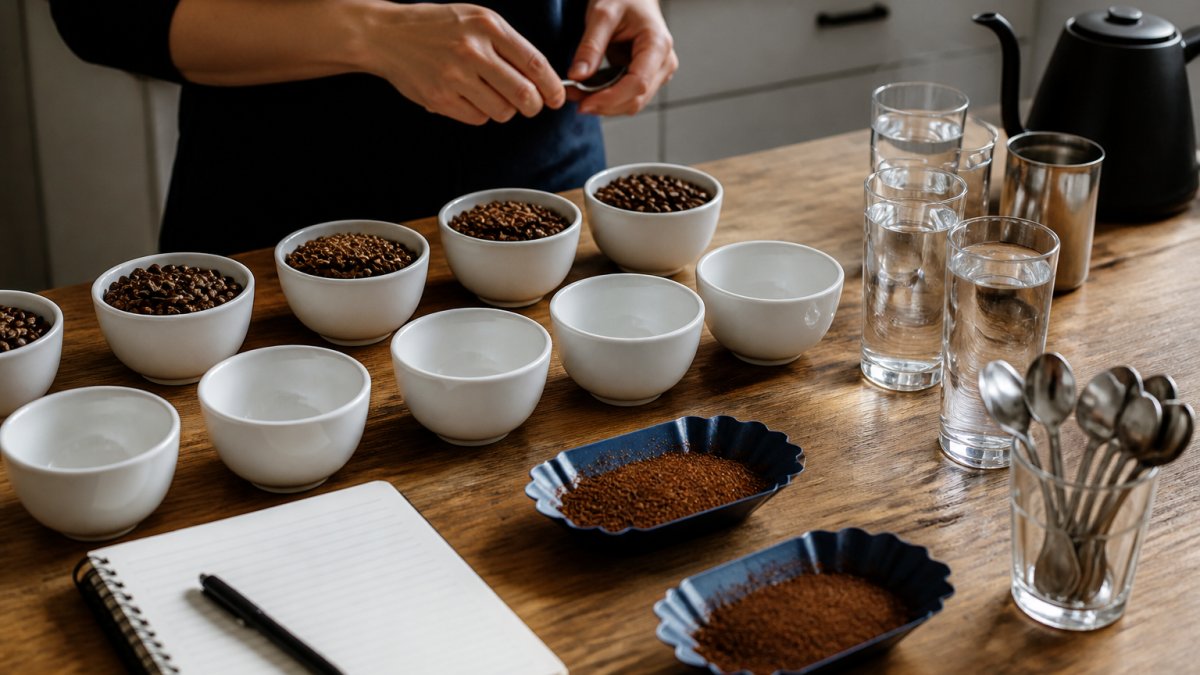
A coffee cupping is a repeatable tasting method: you steep ground coffee in hot water, break the crust, and slurp from a spoon to spread the liquid across your palate. Most guides stop at the steps. The real skill is running the same routine every time so your palate learns to separate fruit from acidity, fermentation, and roast.
The Basic Protocol
- Weigh 8.25 grams of coffee per 150 ml of water.
- Grind medium-coarse, like sea salt.
- Heat water to just off boiling, around 200°F.
- Pour over the grounds and let it steep for 4 minutes.
- Break the crust with a spoon and smell.
- Skim the foam, then let it cool a few minutes.
- Slurp from a spoon and note what you taste.
Slurping matters. It sprays coffee across your whole tongue, so you catch more of the fruit.
A Repeatable Four-Pass Tasting Routine
Most tasters take one sip and guess. A better method is four deliberate passes on the same cup:
- Pass 1, Dry aroma: Smell the ground coffee before water hits it. Fruit notes often show here first, especially berry and citrus.
- Pass 2, Wet aroma: Smell the crust right after pouring. Heat releases volatile compounds; this is where tropical and floral notes often appear.
- Pass 3, Hot taste: Slurp at around 160°F. Note acidity and body, but expect fruit to be muted.
- Pass 4, Cool taste: Wait until the cup drops to roughly 120°F, then slurp again. This is where stone fruit, dried fruit, and sweetness usually emerge.
Write one word per pass. Over several cups, patterns appear.
Calibrating Your Palate Before You Cup
Your palate needs a baseline. Before you cup, taste a few reference flavors: a slice of lemon, a few berries, a square of dark chocolate.
This trains your brain to match what you smell and taste to real fruit. It sounds simple. It works.
A common pattern is that tasters who skip calibration default to "fruity" for everything. Tasters who calibrate start naming specific fruits within a few sessions.
Troubleshooting Muted or Sharp Fruit
If fruit notes seem missing or harsh, adjust one variable at a time:
- Fruit muted: Grind slightly coarser or lower water temperature by 5°F. Over-extraction flattens delicate notes.
- Fruit sharp or sour: Grind finer or raise temperature slightly. Under-extraction reads as sourness, not fruit.
- Fruit muddy: Reduce agitation during the pour. Too much stirring pulls bitter compounds that mask fruit.
- Fruit inconsistent: Weigh your dose and water every time. Eyeballing creates noise that hides real notes.
A Simple Note-Taking Template
Use four columns: Aroma, Acidity, Sweetness, Fruit. Under Fruit, write the family first (citrus, berry, stone, tropical, dried), then the specific note if you can. "Berry, blueberry" is more useful than "fruity." Keep notes for every cup so you can compare across origins and processes.
Separating Fruit Notes from Acidity, Fermentation, and Roast
Fruit flavor is not the same as acidity. Acidity is the lively, mouth-watering sensation. Fruit is the actual aroma and taste, like blueberry or peach.
You can have high acidity with no fruit. You can have fruit with low acidity. They travel together often, but they are separate.
Fermentation is another trap. A natural process can push big, jammy, winey flavors.
Roast changes everything too. A light roast keeps fruit bright and clear. A dark roast burns those notes into smoke and bitter cocoa.
- Acidity: the tingle, not the flavor
- Fruit: the aroma and taste, named
- Fermentation: jammy, winey, boozy depth
- Roast: light keeps fruit, dark hides it
Best Brewing Methods for Fruity Coffee
The best brewing methods for fruity coffee are pour-over and other filter methods that brew clean and clear. They let delicate fruit notes through instead of burying them.
Pour-over, Chemex, and Aeropress all work well. They give you control over temperature and time, which matters for fruit.
Here is how the main methods compare:
| Method | Fruit Clarity | Best For |
|---|---|---|
| Pour-over | High | Naming subtle notes |
| Chemex | High | Clean, bright cups |
| Aeropress | Medium-high | Fast, strong cups |
| French press | Medium | Fuller body, less clarity |
| Espresso | Medium | Concentrated fruit, harder to read |
For a bright African coffee, we reach for a pour-over. For a deeper, jammy cup, a French press works. The method should match the bean.
Our Ethiopia Natural is a natural-process coffee that shows blueberry and strawberry jam, with jasmine and rose on top. Our Kenya leans bright and juicy, with blackcurrant and raspberry jam.
When Elevation Claims Fall Short: Limits and Variability
Elevation is a strong signal, not a guarantee. A high-altitude label does not promise fruit.
Plenty of high-grown coffee tastes plain. Poor processing, bad storage, or a heavy roast can flatten any bean.
So treat elevation as one clue among many. Look at the whole picture: origin, process, roast level, and freshness.
That is why we source from high-elevation estates and roast to order.
If you want to taste the difference for yourself, start with a coffee known for fruit and cup it slowly.
Frequently Asked Questions
What makes coffee taste fruity?
Fruit flavors in coffee come from three main sources: the plant itself, the processing method, and the roast. High elevation coffee grows in cooler temperatures, which slows cherry maturation and lets sugars and acids develop more fully inside the bean. Natural and honey processes leave fruit mucilage on the bean during drying, pushing berry and stone fruit notes forward. A lighter roast preserves those acids instead of burning them off. Together, these factors create the fruity character you taste in the cup.
Does high elevation coffee really have more complex flavor?
It often does, but elevation is one variable among many. Cooler temperatures at high elevation slow cherry maturation, which can lead to denser beans and more concentrated acids and sugars. That density supports brighter acidity and layered fruit notes. However, processing method, roast profile, and freshness also shape the final cup. A washed Ethiopian grown at 2,000 meters can taste wildly different from a natural Ethiopian at the same elevation. Use elevation as a starting signal, not a guarantee.
How can I improve my coffee tasting skills at home?
Start with a consistent cupping routine. Grind the same weight of coffee for each sample, use water just off the boil, and taste at the same temperature every time. Keep a flavor wheel guide nearby to match what you smell and taste to specific descriptors like citrus, berry, or stone fruit. Taste two coffees side by side to compare. Over several sessions, your palate learns to separate acidity from sweetness from fruit. A notebook helps you track what you noticed and how it changed as the cup cooled.
What are the most common fruit notes in high elevation coffee?
Citrus notes like lemon, orange, and bergamot appear often in washed African coffees. Berry notes such as blueberry, strawberry, and blackcurrant show up in natural-process Ethiopian and Kenyan lots. Stone fruit notes like peach, apricot, and nectarine are common in Colombian and Central American coffees. Tropical notes like pineapple and mango appear in some natural and honey-processed lots. Dried fruit notes like raisin, prune, and date tend to emerge in darker roasts or older beans.
Fruity notes can feel out of reach when your coffee arrives stale or roasted too dark. Everything I Need solves that by sourcing from high-elevation estates and roasting to order, so the fruit survives all the way to your kitchen. Our small-batch craft roasting and precision thermal mapping keep each cup clean and sweet, never ashy. Get started with Everything I Need and taste the fruit your coffee has been hiding.