

How to Measure Coffee Grounds Without a Scale
Last Updated: October 29, 2026
Quick Summary
To measure coffee grounds without a scale, use volume: a standard 6-ounce cup of drip coffee takes about 2 level tablespoons of ground coffee, roughly 10 to 12 grams. Pick one scoop or spoon and level every dose so you can measure coffee grounds consistently.
- A level tablespoon of ground coffee holds roughly 5 to 6 grams, and a standard bag scoop holds about 10 grams.
- Use about 2 level tablespoons per 6-ounce cup for drip, pour over, and French press, adjusting grind as needed.
- Level every scoop with the back of a knife; a heaped tablespoon can hold nearly double a level one.
- Fine grounds pack tighter and dark roasts weigh slightly less, so expect your tablespoon count to shift.
Table of Contents
- Why Measuring Coffee Grounds Matters Even Without a Scale
- How Many Tablespoons of Coffee Per Cup
- Using a Coffee Scoop Measurement as Your Standard
- How to Measure Coffee for Pour Over Without a Scale
- Coffee Measurements for 10 Cups
- Why Whole Beans and Grind Size Change Your Measurements
- Fixing Weak or Bitter Coffee by Adjusting Your Measurements
- Building Your Own Measuring Routine at Home
- Frequently Asked Questions
Measuring coffee grounds without a scale is simple once you know a few reliable conversions. A standard tablespoon holds roughly 5 to 6 grams of ground coffee, and a standard scoop from most bags holds about 10 grams. Those numbers give you a working starting point, even if you never weigh a single dose. This guide from Everything I Need walks through how to measure coffee grounds without a scale, from single cups to full pots, and explains where volume measures stop being accurate.
Why Measuring Coffee Grounds Matters Even Without a Scale
Coffee strength depends on how much coffee you use relative to water. Too little grounds and the cup tastes thin and sour. Too much and it turns harsh and bitter. Measuring gives you a repeatable starting point, so you can tell whether a change in taste came from your grind or your dose.
A scale is the most precise tool, but most home brewers do not own one. Volume measures work well enough when you stick to one method and one bag of coffee.
How Many Tablespoons of Coffee Per Cup
For a standard 6-ounce cup of drip coffee, most brewers start with about 2 level tablespoons of ground coffee. That lands near the widely used coffee-to-water ratio of roughly 1:16, one part coffee to sixteen parts water by weight, which is why a 6-ounce cup (about 177 milliliters of water) pairs with roughly 10 to 11 grams of grounds.
The trouble is that a tablespoon is a volume measure, not a weight. The weight of a level tablespoon moves with grind size, roast level, and how firmly the spoon is filled. Use the table below as a starting grid, then let taste correct it.
Dose |
Level tablespoons |
Approx. grams |
Best for |
|---|---|---|---|
Light, mild cup |
1.5 tbsp |
8-9 g |
6-oz drip, delicate roasts |
Balanced cup |
2 tbsp |
10-12 g |
6-oz drip, most daily drinking |
Strong cup |
2.5 tbsp |
13-15 g |
6-oz drip, darker roasts, milk drinks |
Mug-size cup |
3 tbsp |
15-18 g |
10-12 oz mug |
A few practical notes on reading that grid:
- Grind shifts the number. Fine grounds pack tighter, so a level tablespoon can hold closer to 6 grams; coarse grounds sit looser and may hold closer to 5. If you switch from drip to French press, expect your tablespoon count to drift by half a tablespoon or so for the same cup.
- Roast shifts it too. Dark roasts lose more moisture during roasting and are less dense, so the same scoop weighs slightly less than a scoop of a light roast.
- Scoop size is not standardized. Generic scoops vary. Measure your scoop once against a measuring spoon so you know what you are actually dosing.
- Level, don't heap. A heaped tablespoon can hold nearly double a level one. Level with the back of a knife for anything you plan to repeat.
Adjust in small steps. A change of half a tablespoon makes a noticeable difference in a single cup, so move in that increment before jumping to a full tablespoon.
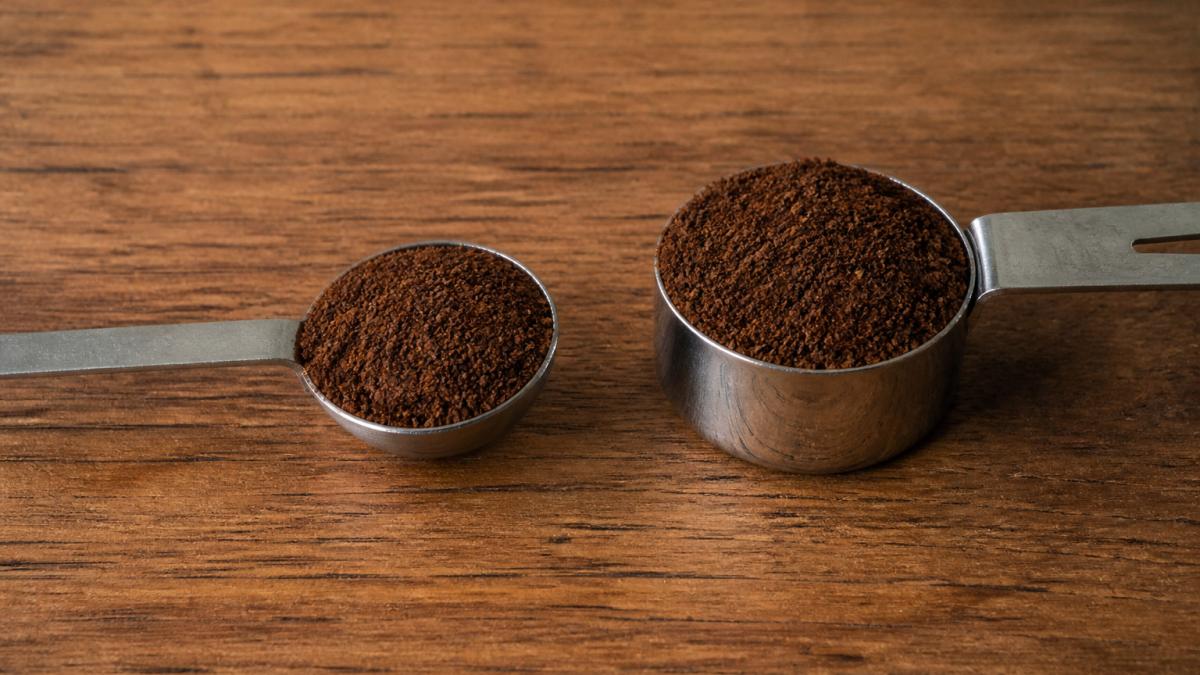
Using a Coffee Scoop Measurement as Your Standard
Level any scoop with the back of a knife so every dose matches.
Pick one scoop and use it every time. Consistency matters more than exact accuracy, because your taste will tell you when the dose needs to change.
How to Measure Coffee for Pour Over Without a Scale
Pour over is less forgiving than a drip machine because the water passes through the bed once, by hand, at a pace you control. Dose and grind both matter more, and the same 2-tablespoon scoop that works in a drip basket can taste thin or muddy in a cone.
Start with about 2 level tablespoons (roughly 10 to 12 grams) for a 6-ounce cup, then scale by cup count rather than guessing at the cone's capacity:
Cups (6 oz each) |
Level tablespoons |
Approx. grams |
Water |
|---|---|---|---|
1 |
2 |
10-12 g |
6 oz |
2 |
4 |
20-24 g |
12 oz |
4 |
8 |
40-48 g |
24 oz |
Use a slightly finer grind than a standard drip machine, closer to medium-fine, like table salt, and let the grounds settle naturally in the filter. Follow a beginner walkthrough of the full pour over process from start to finish. Do not pack them down; a packed bed slows the drawdown and pushes extraction toward bitter.
How the other methods differ. One measure does not fit every brewer, so adjust the dose and grind together:
- Pour over: 2 level tablespoons per 6-ounce cup, medium-fine grind, gentle pours. Watch the drawdown, if it stalls, the grind is too fine or the bed is packed.
- French press: 2 to 2.5 level tablespoons per 6-ounce cup, coarse grind like sea salt. The full-immersion steep extracts more, so a slightly coarser grind and a slightly larger dose keep it from turning heavy.
- Drip machine: 2 level tablespoons per 6-ounce cup, medium grind. The machine controls the pour, so dose is the main lever.
- Single-cup pour over (small cone): 1.5 to 2 level tablespoons for a 6-ounce cup; small cones lose heat fast, so keep the dose modest and the pour quick.
Measuring the water without a scale. Water is easy: 1 fluid ounce weighs about 29.6 grams, so a 6-ounce cup is roughly 177 milliliters (Approximate Conversions from U.S. Customary Measures to Metric | NIST). Use a liquid measuring cup marked in ounces or milliliters and match the coffee to it, not the other way around. If your kettle has no markings, fill your mug first, pour that into the kettle, and use the mug as your water unit.
Coffee Measurements for 10 Cups
For larger batches, scale up the single-cup amount. Ten 6-ounce cups use about 20 tablespoons, or roughly 1 cup of ground coffee, which is close to 10 scoops.
- Measure the water first, then match the coffee to it.
- Use the same scoop or spoon for every batch.
- Write down what you used so you can repeat or adjust it.
Why Whole Beans and Grind Size Change Your Measurements
Volume is not weight. A tablespoon of finely ground coffee holds more mass than a tablespoon of coarse grounds, because fine particles pack tighter. Whole beans also take up more space than ground coffee, so a scoop of beans weighs more than a scoop of grounds only in a different sense: the volume is larger, but the coffee-to-water balance shifts once the beans are ground.
If you switch grind sizes, expect your measurements to change. Adjust your tablespoon count by a small amount and taste the result.
Fixing Weak or Bitter Coffee by Adjusting Your Measurements
If your coffee tastes weak or sour, add a little more grounds, roughly half a tablespoon per cup, before you change anything else. If it tastes bitter or harsh, use slightly less coffee or a coarser grind.
Watch out: changing more than one variable at a time makes it hard to know what fixed the cup. Change the dose first, then the grind.
Building Your Own Measuring Routine at Home
A simple routine keeps your coffee consistent without a scale:
- Choose one scoop or spoon and keep it in the same place.
- Level every dose and use the same brewing method each time.
- Record your dose, grind setting, and taste notes for a week.
- Adjust one thing at a time until the cup tastes right.
Once your routine is set, you can brew confidently even without weighing anything. You can also try our instant coffee for a dark chocolate and toasted caramel cup that dissolves in hot or cold water.

Frequently Asked Questions
How do you measure coffee grounds without a scale?
Use a tablespoon or a coffee scoop as your unit of measure. A standard tablespoon holds roughly 5 to 7 grams of ground coffee depending on grind size, so a starting point of about one tablespoon per 6 ounces of water gives a moderate cup. Level each spoonful and keep the same method every time so your results stay repeatable. Because volume measures vary with grind and how tightly the grounds are packed, expect some variation from brew to brew and adjust by taste.
How many tablespoons of coffee per cup should I use?
A common starting point is about one level tablespoon of ground coffee for each 6-ounce cup of water. Many drinkers prefer a slightly stronger brew, so increasing to one and a half tablespoons per cup is a reasonable next step. Keep the water amount fixed while you test, change only the coffee, and note what tastes best. Whole beans measure differently than ground coffee, so if you switch forms, re-test your spoonful count.
How do I measure coffee for pour over without a scale?
Start with about one level tablespoon of medium-fine ground coffee per 6 ounces of water, then pour slowly in stages so the grounds bloom and extract evenly. Use a measuring cup marked in ounces to set your water volume before you brew. If the cup tastes sour, use a little more coffee or grind slightly finer. If it tastes bitter or harsh, use slightly less coffee or grind a touch coarser.
How many scoops of coffee grounds do I need for 10 cups?
For 10 six-ounce cups, a common starting point is roughly 10 level tablespoons. Check how much your scoop holds by filling it and leveling it once, then count how many fills equal 10 tablespoons. Using the same scoop each time keeps your batches consistent without a scale.
