

How to Store Specialty Coffee Beans for Freshness
Table of Contents
- Why Freshness Fades: The Science of Coffee Staling
- The Best Coffee Storage Containers for Peak Freshness
- Freezing Coffee Beans: When It Works and When It Backfires
- How to Tell If Coffee Beans Are Stale
- Altitude, Humidity, and Your Kitchen Environment
- How to Store Specialty Coffee Beans: A Step-by-Step Routine
- Tracking Shelf Life After Opening
- Frequently Asked Questions
Last Updated: September 15, 2026
Why Freshness Fades: The Science of Coffee Staling
Roasted coffee begins losing quality the moment it leaves the roaster. Understanding why is the first step in learning how to store specialty coffee beans for freshness.
Staling is driven largely by oxidation, where oxygen reacts with coffee oils and aromatic compounds, producing flat, papery, or rancid notes. Moisture accelerates this breakdown, heat speeds up every reaction, and light degrades oils directly.
Roasted beans also release carbon dioxide for days after roasting, a process called degassing (Carbon monoxide emission rates from roasted whole bean and ground coffee). That gas displaces oxygen inside a sealed container, which is why fresh coffee packaging is more technical than most people assume.
Oxidation, Moisture, Heat, and Light: The Four Enemies
These four enemies rarely act alone. A warm, humid kitchen with a clear glass jar on the counter delivers all of them at once.
- Oxygen: Drives oxidation of coffee oils and volatile compounds, flattening aroma first, then sweetness
- Moisture: Encourages chemical degradation and can introduce mold in extreme cases
- Heat: Roughly doubles the rate of staling reactions with every significant temperature increase
- Light: Ultraviolet exposure breaks down oils and accelerates rancidity
Control all four simultaneously, or the weakest link sets your shelf life.
The Best Coffee Storage Containers for Peak Freshness
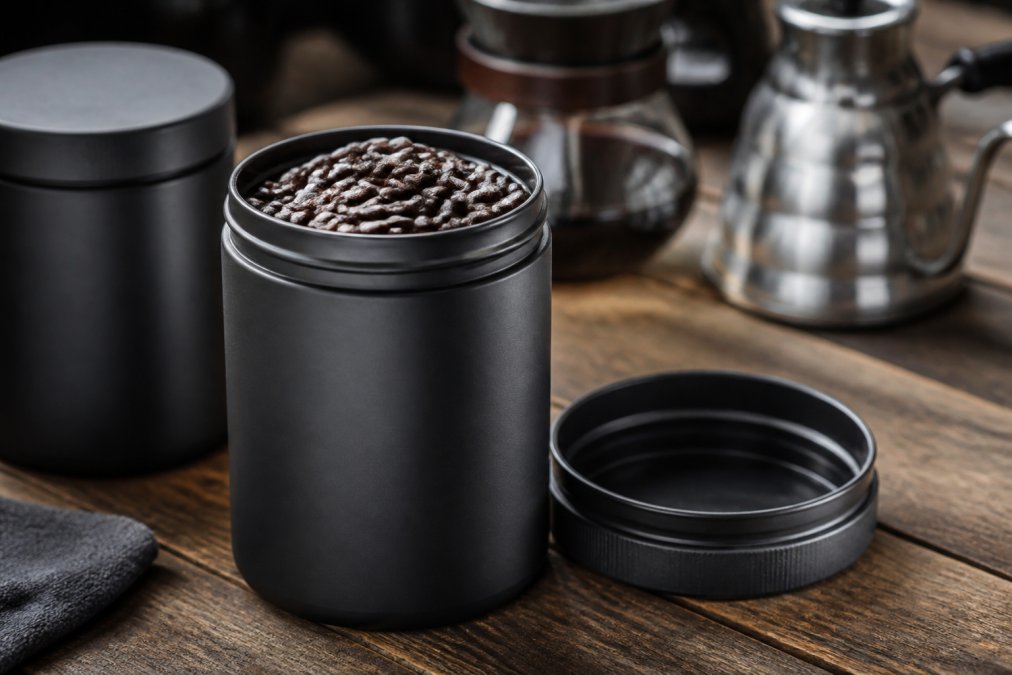
The best coffee storage containers combine an airtight seal, an opaque body, and a size matched to how much coffee you use in a week or two.

A common mistake is buying a large canister and filling it once a month. Every opening exchanges the protective carbon dioxide blanket for fresh oxygen; smaller vessels refilled more often keep headspace gas more stable.
The variable most guides skip is headspace geometry. A tall, narrow container with a small opening exposes less bean surface to incoming air than a wide, shallow one of the same volume. For one-cup brewing, a narrow-mouth vessel holding roughly 8-12 ounces keeps the internal atmosphere closer to its post-roast equilibrium than a wide canister holding a full pound.
Material Science: Glass, Stainless Steel, and Ceramic Compared
Material choice matters less than seal quality and opacity, but it still shapes long-term performance.
Material |
Light Protection |
Seal Potential |
Chemical Interaction |
Best For |
|---|---|---|---|---|
Clear glass |
None |
Good with gasket lid |
Inert; no off-flavor transfer |
Short-term display use only |
Amber or coated glass |
Partial |
Good with gasket lid |
Inert; blocks some UV |
Short-term storage in a dark cabinet |
Stainless steel |
Complete |
Excellent |
Inert; no reaction with oils |
Everyday storage, easy to clean |
Ceramic (opaque, glazed) |
Complete |
Very good |
Inert if glaze is intact; unglazed clay can absorb oils and odors over time |
Countertop storage you want visible |
Vacuum-sealed plastic |
Complete |
Excellent |
Food-grade barrier films are inert; thin bags can allow slow oxygen permeation over months |
Long-term freezer portions |
Matte or unglazed ceramic |
Complete |
Varies |
Porous surface traps oils and can carry stale aromas between batches |
Not recommended for repeat use |
Stainless steel and glazed opaque ceramic are the strongest everyday choices: both are fully opaque, non-porous, and inert against the oils and acids that coat any container within a few uses. Glass only works in a dark cabinet, with a shorter window. Unglazed clay, often sold as a "breathable" keeper, lets oxygen and moisture through the wall and accelerates staling.
For freezer portions, use a vacuum-sealed barrier bag rather than a rigid container. Rigid containers waste freezer space and trap the air you were trying to remove; a vacuum bag collapses around the beans, eliminating headspace entirely.
Why One-Way Valve Bags Still Matter
A one-way valve bag lets carbon dioxide escape while blocking outside oxygen. It solves a real problem: freshly roasted beans degassing in a fully sealed bag would inflate it or force the seal open, exposing the coffee to air.
This is why roasters ship in valve bags rather than vacuum-sealed bricks: the valve keeps the internal atmosphere rich in carbon dioxide during the first week or two, when degassing is most active. Once degassing slows, the bag becomes a mediocre container, not rigid, not fully opaque, and reopening to a large volume of air.
Matching Container Size to Your Brewing Pace
The most useful container decision is sizing, not material. A container holding exactly what you brew in 5-7 days keeps the headspace gas stable; one holding a month of beans exposes most of the coffee to fresh oxygen dozens of times before you finish it.
A workable rule: weigh your daily dose, multiply by seven, and pick a vessel holding that amount with minimal empty space. Brewing 18 grams twice a day means about 252 grams per week, roughly a 9-ounce vessel. Most decorative canisters hold two to three times that, which is why they underperform even with a good seal.
Freezing Coffee Beans: When It Works and When It Backfires
Freezing coffee beans works for long-term storage when you freeze whole beans in airtight, single-use portions and never let them thaw and refreeze. It backfires when you freeze a large bag you keep opening, or when moisture condenses during repeated thaw cycles.
The freezer slows oxidation and volatile loss dramatically, but moisture is the problem: every time you pull a container out, warm air meets cold beans and condenses on the surface, degassing aroma compounds and degrading oils.
The fix is portioning: divide your beans into amounts you will use in a few days, seal each portion airtight, and thaw only what you need.
Long-Term vs. Short-Term Storage Protocols
Treat these as two different jobs.
- Short-term (under two weeks): Airtight, opaque container at room temperature, away from the stove, in a cool, dark place. Use it daily.
- Long-term (over two weeks): Portion into airtight bags or vacuum-sealed packs, freeze immediately after roasting, and thaw one portion at a time without refreezing.
The mistake most people make is mixing the two. Pick one protocol per batch and commit to it.
How to Tell If Coffee Beans Are Stale
You can usually tell if coffee beans are stale within seconds of opening the container.
- Aroma: Fresh beans smell sweet, complex, and roast-forward. Stale beans smell flat, papery, or like cardboard.
- Appearance: Fresh beans have a slight oily sheen on darker roasts. Very dull, dry-looking beans have often lost their volatile oils.
- Sound: Fresh beans crack softly when you bite one.
Altitude, Humidity, and Your Kitchen Environment
How to Store Specialty Coffee Beans: A Step-by-Step Routine
Tracking Shelf Life After Opening
A Simple Post-Opening Log
Peak Windows by Roast Level
Roast Level |
Rest After Roast |
Peak Window After Opening (pantry) |
Peak Window After Opening (frozen portions) |
|---|---|---|---|
Light |
7-10 days |
10-14 days |
6-8 weeks |
Medium |
5-7 days |
12-18 days |
8-10 weeks |
Dark |
3-5 days |
7-12 days |
4-6 weeks |
When to Move Beans to the Freezer Mid-Bag
Frequently Asked Questions
How long do coffee beans stay fresh in a sealed bag?
Whole bean coffee stays at peak freshness for about 2 to 4 weeks after the roast date if kept in an unopened, valve-sealed bag stored in a cool, dark place. Once you open the bag, the clock accelerates: aim to finish it within 2 weeks for the best flavor. Beyond 6 weeks, oxidation and moisture exposure will dull the aroma and flatten the flavor profile, even if the beans are still technically safe to brew.
Is it better to store coffee beans in glass or stainless steel?
Both glass and stainless steel work well if the container is opaque and airtight. Stainless steel blocks light completely and resists odor absorption, making it a strong choice for long-term storage. Glass lets you see the beans but must be opaque or kept in a dark cabinet to prevent light exposure. Avoid clear glass on open shelves; UV light accelerates the chemical degradation of coffee oils and volatile compounds.
Should you store specialty coffee beans in the freezer?
Freezing coffee beans works if you follow strict rules: use an airtight, opaque container, freeze in single-use portions, and never thaw and refreeze. Moisture is the risk. Every time you pull beans out, condensation forms on the surface, which degrades bean integrity. For daily brewing, keep a 1-week supply at room temperature and freeze the rest. This approach preserves peak freshness for up to 2 months.
How can I tell if my coffee beans are stale?
Stale beans lose their aroma first. Fresh beans smell sweet and complex; stale beans smell flat, papery, or like cardboard. Visually, stale beans look dull and dry rather than slightly oily. When brewed, stale coffee tastes muted, bitter, or ashy with no sweetness. If your beans are more than 6 weeks past the roast date and lack aroma when you open the bag, they have likely passed their brewing window.