

Specialty Coffee Processing Methods and Flavor
Last Updated: October 22, 2026
Quick Summary
Coffee processing is the series of steps that turns a harvested coffee cherry into stable green coffee ready for roasting, and it is the most decisive variable a producer controls after picking. Fermentation and drying matter most for flavor, shaping acidity, sweetness, body, and aroma before the roaster touches the bean.
- Washed coffee removes fruit before drying for a clean, precise cup with sharper acidity.
- Natural coffee dries the whole cherry around the seed, yielding heavier body and fruit-forward character.
- Honey process leaves mucilage on the seed, landing between washed and natural with rounded sweetness.
- Anaerobic coffee ferments in sealed tanks, letting producers steer flavors from tropical to spice-driven.
- Processing influences flavor but does not determine it; origin, variety, harvest, and roast all shape the cup.
Table of Contents
- What Coffee Processing Is and Why It Changes Everything
- Washed vs Natural Coffee: Clean Precision or Fruit-Forward Depth
- Honey Process Coffee Flavor: Sweetness Between Two Extremes
- Anaerobic Fermented Coffee: Controlled Fermentation and New Flavors
- Coffee Processing and Acidity: What the Method Does to the Cup
- How Origin, Variety, Harvest, and Roast Interact With Processing
- Tasting and Buying: Matching a Process to Your Palate
- Frequently Asked Questions
What Coffee Processing Is and Why It Changes Everything
Coffee processing is the series of steps that turns a harvested coffee cherry into stable green coffee ready for roasting. It is the most decisive variable a producer controls after picking, shaping acidity, sweetness, body, and aroma before the roaster touches the bean. At Everything I Need, we source from high-elevation estates where processing decisions are made deliberately, because the cup we roast is only as expressive as the work done at origin.
The path from cherry to green coffee follows a consistent sequence, though the details shift by method:
- Harvesting - selective picking of ripe cherries
- Sorting and floating - removing underripe, overripe, and defective fruit
- Pulping or depulping - separating the skin and fruit from the seed
- Fermentation - breaking down mucilage, the sticky layer clinging to the seed
- Washing - rinsing away residual mucilage
- Drying - reducing moisture on raised beds or patios until the green coffee is stable
- Resting and milling - stabilizing, hulling, and preparing for export
The stages that matter most for flavor are fermentation and drying. Everything else sets the stage.
Washed vs Natural Coffee: Clean Precision or Fruit-Forward Depth
Washed coffee removes the fruit before drying, producing a clean, precise cup; natural coffee dries the whole cherry around the seed, producing a heavier, fruit-forward profile.
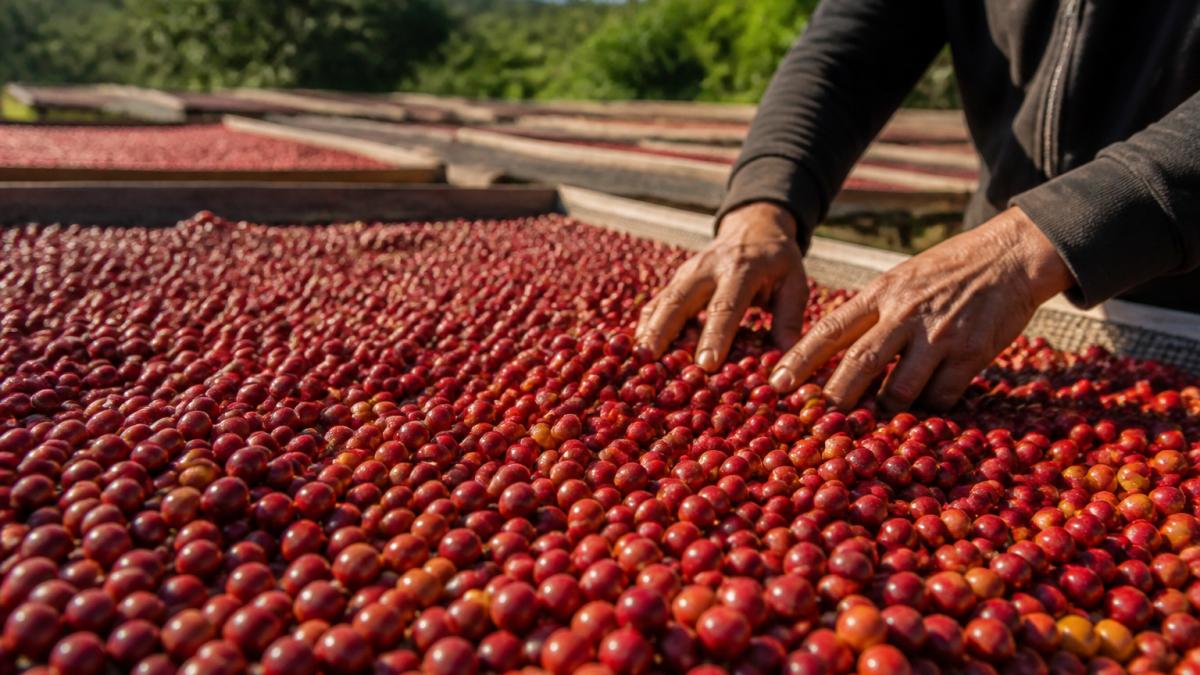
Close-up of whole coffee cherries drying on a raised bed in warm sunlight, with a worker's hands turning them, showing the fruit still intact on the bean
How the Washed Process Works
In the washed process, also called the wet process, producers pulp the cherry within hours of picking, ferment the seed to break down mucilage, then wash it clean in channels or tanks before drying. Water use is significant, which is why washed lots command attention at origins with reliable water access. The payoff is clarity: washed coffees express variety and terroir with minimal interference from fruit, with sharper acidity, cleaner structure, and defects that are easier to spot.
How the Natural Process Works
The natural process, or dry process, spreads whole cherries on raised beds or patios and lets them dry intact, turning them regularly over days to weeks. The fruit ferments slowly around the seed, imparting sugars and aromatic compounds directly into the bean, yielding heavier body, lower perceived acidity, and pronounced fruit-forward character. The trade-off is risk: uneven drying invites mold and fermentation defects, so natural lots demand constant attention and stable weather.
Method |
Fruit Contact |
Acidity |
Body |
Typical Flavor Direction |
|---|---|---|---|---|
Washed |
Removed before drying |
High, precise |
Light to medium |
Clean, bright, varietal |
Natural |
Whole cherry intact |
Lower, rounded |
Heavy, syrupy |
Fruit-forward, wine-like |
Honey |
Mucilage retained |
Medium |
Medium |
Sweet, balanced, stone fruit |
Honey Process Coffee Flavor: Sweetness Between Two Extremes
Honey process coffee flavor lands between washed and natural: producers remove the skin but leave some or all of the mucilage on the seed during drying, yielding a cup with rounded sweetness and moderate acidity. The name comes from the sticky, honey-like mucilage, not from any added sweetener.
The variations depend on how much mucilage remains:
- White honey - most mucilage removed, closest to washed, clean and delicate
- Yellow honey - light mucilage retained, gentle sweetness
- Red honey - moderate mucilage, fuller body and stone-fruit notes
Honey lots are demanding to dry because the mucilage holds moisture and invites fermentation if airflow is poor.
Anaerobic Fermented Coffee: Controlled Fermentation and New Flavors
Anaerobic fermented coffee is processed in sealed tanks where oxygen exposure is restricted, letting producers control fermentation with far more precision than open-air methods.
Two distinct approaches share the anaerobic label:
- Anaerobic fermentation - sealed tanks with a one-way valve releasing gas, typically hours to days
- Carbonic maceration - whole cherries sealed under a pressurized gas environment, borrowed from winemaking
The distinction matters: carbonic maceration tends toward vivid, candy-like fruit, while straight anaerobic fermentation tends toward deeper, more fermented character. Both carry risk, sealed tanks hide problems until opened, and a stalled or overheated fermentation can ruin a lot outright.
Coffee Processing and Acidity: What the Method Does to the Cup
Coffee processing and acidity are tightly linked, but the relationship is more mechanical than most bag labels suggest. The method sets the direction; fermentation time, temperature, oxygen exposure, drying speed, and moisture targets set the magnitude.
What "Acidity" Actually Means in the Cup
Perceived acidity is not a single compound but the combined sensory impression of organic acids, chiefly citric, malic, lactic, acetic, and chlorogenic derivatives, balanced against sugars, body, and aromatics. A washed coffee reads "bright" because it retains a sharper acid profile with little fruit-derived sweetness to round it off; a natural reads "soft" because extended fruit contact and slower drying convert or mask some acids while adding ferment-derived compounds.
How Each Stage Moves the Acid Profile
Pulping and mucilage removal. Removing fruit early limits the substrate available for fermentation.
Fermentation time and temperature. Longer, warmer fermentations push acidity down and fermented or boozy notes up, while shorter, cooler fermentations preserve sharper acidity.
Oxygen exposure. Aerobic fermentations tend to favor acetic acid development, which can read as vinegar-like at high levels.
Drying speed and moisture targets. Slow, shaded drying preserves organic acids and aromatic precursors; fast, hot drying flattens them and drives off volatiles.
A Practical Way to Read Acidity on a Label
When you see a process label, translate it into likely acid behavior:
- Washed, expect higher, more precise acidity; the variety and terroir are doing most of the talking.
- Honey, expect medium acidity with sweetness rounding the edges; the mucilage level tells you how far toward natural it leans.
- Natural, expect lower perceived acidity and more fruit-forward, fermented character.
Perceived acidity also depends on drying and rest. A washed lot dried slowly under shade will often show more layered acidity than one dried fast on hot concrete, even with the same label. When we evaluate a lot for our lineup, we cup for acidity first, because it tells us more about the processing than any label claim.
How Origin, Variety, Harvest, and Roast Interact With Processing
Processing never works alone. It is one variable in a chain, and the same method applied to two different coffees produces two different results. Processing amplifies or suppresses what origin, variety, harvest, and roast already provide, a distinction that matters when predicting what a bag will taste like.
Origin Sets the Baseline
Elevation, rainfall, soil, and diurnal temperature range shape the raw material before a cherry is picked. High-elevation lots tend to develop denser beans and more layered acidity; lower-elevation lots tend to be rounder and less acidic. A natural process on a high-elevation landrace can yield floral, berry-driven complexity because there is complexity to amplify; the same method on a lower-grown, high-yield variety can read flat and fermenty.
Variety Determines What Processing Can Express
Some varieties carry distinctive aromatics, floral, citrus, berry, that survive fermentation and drying well; others are valued for body, yield, or disease resistance and have a narrower aromatic range. A washed process preserves delicate florals; a heavy natural or anaerobic process can bury them. Producers choose methods partly based on what a variety does well, which is why the same farm may wash one lot and natural-process another.
Harvest Conditions Set the Ceiling
Ripe, selectively picked cherries give a producer clean material. A mixed pick, underripe, ripe, and overripe fruit together, forces heavier processing to compensate, and that usually shows up as inconsistency rather than character. Cherries picked at peak sugar development ferment more predictably. When a lot tastes muddy, the cause is often the pick, not the process.
Roast Level Decides How Much Reaches the Cup
Roast is the final filter. A light roast preserves the delicate fermentation and origin notes a producer worked to create; a darker roast can bury them under caramelization, smokiness, and bitterness that flatten processing differences. Comparing two processes at different roast levels is misleading, you may be tasting the roast, not the method. We roast to order and map thermal profiles carefully so the process speaks rather than the drum.
A More Accurate Way to Interpret Tasting Differences
When two coffees taste different, resist assigning the difference entirely to processing. Ask instead:
- Are they the same variety and origin? If not, processing is only part of the story.
- Were they roasted to the same level? A darker roast can mimic the body of a natural.
- Were they brewed the same way? Grind, ratio, and water chemistry can shift perceived acidity more than processing.
This is also why we source with flexibility in mind: the same origin can yield a washed lot for clarity and a natural lot for depth, and matching the process to the variety and harvest is what makes either worth roasting.
Tasting and Buying: Matching a Process to Your Palate
Match the process to what you actually enjoy, not to what sounds most impressive. Want clarity and structure? Start with washed. Fruit and weight? Go natural. Sweetness without intensity? Honey is the middle path.
Our single-origin lineup makes the comparison concrete:
Coffee |
Process Character |
What to Expect |
|---|---|---|
Natural, raised-bed dried |
Blueberry, strawberry jam, jasmine, wine-like body |
|
Meticulous wet processing |
Red apple, white peach, milk chocolate, precise acidity |
|
Balanced washed |
Caramel, red grape, nectarine, clean finish |
|
Traditional wet-hulling |
Dark chocolate, dried fruit, earthy, syrupy body |
|
Wet-hulled, organic |
Dark chocolate, cedar, clove, low soft acidity |
A practical buying checklist:


- Decide whether you want clean precision or fruit-forward depth
- Check the stated process, not just the origin name
- Buy a small amount of any anaerobic lot before committing
Frequently Asked Questions
What are the main coffee processing methods?
The four you will see named on most specialty bags are washed, natural, honey, and anaerobic. Washed removes the fruit before drying, natural dries the whole cherry, honey leaves part of the mucilage on the bean, and anaerobic ferments the cherry in a sealed environment before drying. Each method steers flavor in a different direction, which is why two coffees from the same farm can taste nothing alike.
How does coffee processing affect flavor?
Processing decides how much fruit sugar and acid reach the bean before drying. Natural and honey methods leave fruit material in contact with the seed, producing sweeter, heavier, fruit-forward cups. Washed methods strip the fruit early, giving cleaner, brighter cups where acidity and origin character come through clearly. Anaerobic fermentation adds layered notes that go beyond fruit, such as spice, wine, or tropical tones.
What is the difference between washed and natural coffee?
Washed coffee has the cherry skin and pulp removed within hours of harvest, then the bean is fermented briefly to break down mucilage and rinsed before drying. Natural coffee skips that step and dries the whole cherry on raised beds or patios for weeks. Washed cups read clean and bright with defined acidity; natural cups read syrupy, fruit-heavy, and lower in perceived acidity.
Which coffee processing method produces the sweetest flavor?
Natural and honey processes usually land sweetest because fruit sugars stay in contact with the bean during drying. Within honey processing, the black and red honey styles, which leave more mucilage attached, tend to push sweetness and body further than white honey. Washed coffees can still taste sweet, but the sweetness reads as caramel or stone fruit rather than jam.
Does coffee processing affect acidity and body?
Yes, and predictably. Washed coffees typically show the highest perceived acidity and a lighter body because the fruit is removed before drying. Natural coffees trade some of that brightness for a heavier, syrupy body. Honey sits between the two. Anaerobic coffees vary widely but often show rounder acidity with a dense body, since fermentation changes which acids dominate the cup.
How can you tell how a coffee was processed?
Check the bag. Specialty roasters list the process next to the origin and variety, and terms like washed, natural, honey, and anaerobic are standard. If the label is vague, ask the roaster directly or look for a tasting note pattern: heavy berry and jam notes usually point to natural, clean citrus and floral notes to washed, and brown sugar or stone fruit to honey.
Which coffee processing method is best for beginners?
Washed is the easiest starting point because its clean structure makes it simple to taste the difference between origins. Once you know what a washed Colombia or Costa Rica tastes like, a natural Ethiopia gives you a clear contrast. From there, honey and anaerobic coffees make sense as deliberate experiments rather than daily defaults.
Choosing coffee by processing method is the fastest way to close the gap between what a bag promises and what your cup delivers. Everything I Need roasts small batches to order from high-elevation estate beans, using precision thermal mapping to keep bitterness out and let each process express itself fully. Order a single origin or compare a washed and a natural side by side, and let the method do the talking.