

The Beginner's Guide to Fair Trade Coffee Certification
Last Updated: October 29, 2026
Quick Summary
Fair trade coffee certification is a third-party verification system that confirms coffee was produced and traded according to social, economic, and environmental standards. It is not a single global program but a family of labeling schemes, each with its own standards, auditors, and fee structures. Certified coffee should mean farmers were paid a protected minimum price, worked under monitored labor conditions, and farmed with environmental safeguards in place.
- Certification is typically granted to cooperatives or producer groups, not individual smallholders.
- Producer organizations pay an application fee and annual fees, which come out of cooperative funds.
- Certification must be renewed annually, with each cycle bringing another audit and another fee.
- Direct trade is a relationship, not a certification, so no third party checks the claim.
- Certification says nothing about cup score, defect count, or roast quality.
Table of Contents
- What Fair Trade Coffee Certification Actually Means
- How Fair Trade Certification Works, Step by Step
- Fair Trade vs Direct Trade Coffee: What's the Real Difference?
- The Benefits of Fair Trade Coffee for Farmers and Workers
- Environmental Standards and Sustainable Production
- How to Identify Ethically Sourced Coffee
- What the Certification Doesn't Guarantee: Limits and Criticisms
- Choosing Your Next Bag of Coffee
- Frequently Asked Questions
What Fair Trade Coffee Certification Actually Means
Fair trade coffee certification is a third-party verification system that confirms coffee was produced and traded according to social, economic, and environmental standards (How Fairtrade certification works). It is not a single global program but a family of labeling schemes, each with its own standards, auditors, and fee structures.
The core promise is straightforward: certified coffee should mean farmers were paid a protected minimum price, worked under monitored labor conditions, and farmed with environmental safeguards in place. At Everything I Need, we source from high-elevation estates and treat certification as one input in a larger quality decision, not a substitute for it.
Here's what most guides get wrong. They describe certification as a moral seal when it is really an audited contract with defined rules, defined limits, and defined costs.
How Fair Trade Certification Works, Step by Step
The process runs from the farm up, not from the buyer down. A producer group must first organize, then apply, then pass inspection before a single certified bag can be sold. What most guides skip is the machinery between those milestones, the fees, the audit cycle, the corrective-action window, and the chain-of-custody model that determines what the label actually certifies.
- Organize into a cooperative or producer group. Certification is typically granted to groups, not individual smallholders, because group structure makes inspection and premium distribution manageable. The group must have democratic governance, transparent records, and a internal control system that monitors member farms between external audits.
- Apply and pay fees. The producer organization pays an application fee and, once certified, annual fees. Who pays matters: these costs come out of the cooperative's funds before any premium reaches members. A common pattern is that the smallest cooperatives absorb the highest relative cost, which is one reason critics argue certification can exclude the farms it most intends to help.
- Implement the standards. The group must meet requirements covering labor rights, record-keeping, environmental practice, and democratic governance. Standards are updated on a multi-year cycle, so a group certified under one version must transition to the next, another administrative burden that falls on producers.
- Undergo inspection. An independent auditor reviews documents and visits farms to check compliance. Audits are periodic, not continuous. Between audits, the group's internal control system is supposed to catch problems, but enforcement depends on the certifier's follow-up capacity.
- Receive certification and enter the chain of custody. Certified beans must be tracked and segregated from conventional coffee through the supply chain, or, under a mass-balance model, accounted for on paper rather than physically separated. That distinction is legal and disclosed, but it changes what the label tells you.
- Renew annually. Certification is not permanent. Each renewal cycle brings another audit and another fee. Non-compliance found at audit triggers a corrective-action window; failure to close it can suspend certification until the next cycle.
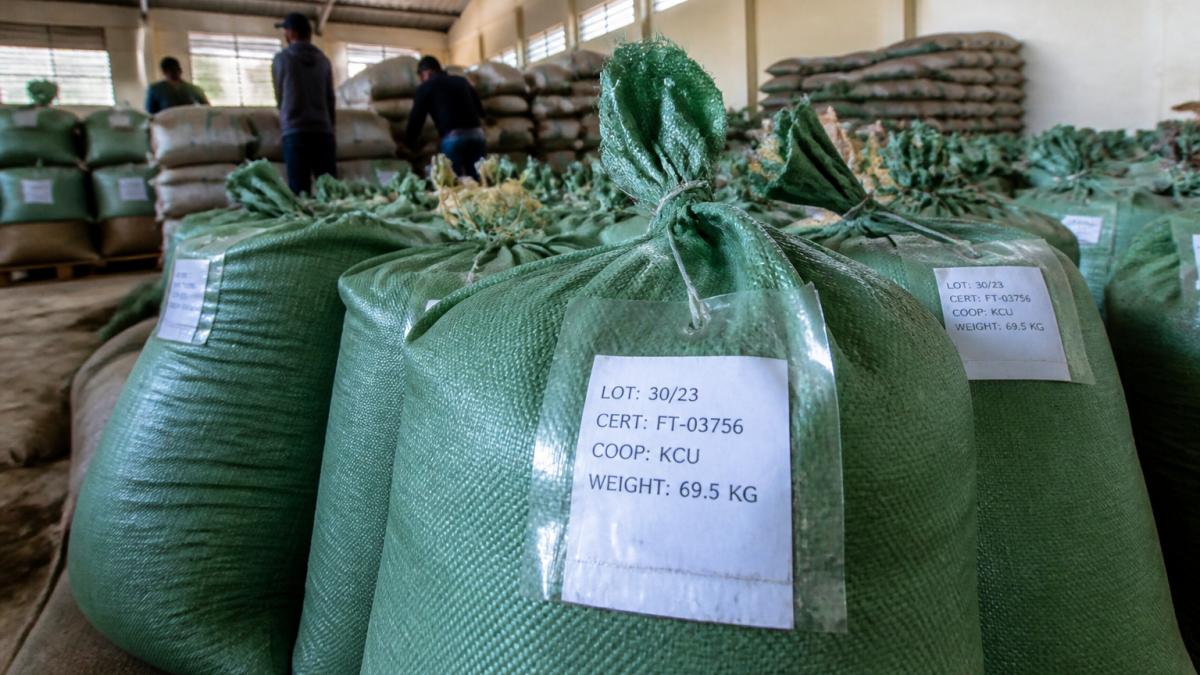
Here is the certification path a producer group must follow, from organizing to annual renewal.
Step |
What happens |
Timing or frequency |
|---|---|---|
Organize |
Form a cooperative or producer group with democratic governance |
Before applying |
Apply and pay fees |
Producer organization pays application fee, then annual fees |
Once certified, annually |
Implement standards |
Meet labor, record-keeping, environmental and governance requirements |
Standards updated on a multi-year cycle |
Undergo inspection |
Independent auditor reviews documents and visits farms |
Periodic, not continuous |
Enter chain of custody |
Beans tracked and segregated, or accounted for under mass balance |
After certification |
Renew |
Another audit and another fee; non-compliance triggers corrective-action window |
Annually |
Fair Trade vs Direct Trade Coffee: What's the Real Difference?
Direct trade is a relationship, not a certification. Fair trade is a verified standard with published rules and independent audits.
That distinction decides everything. A roaster claiming direct trade may have a genuine, long-standing relationship with a single farm and pay well above market rates. Or it may have visited once and put the phrase on a bag. No third party checks.
Fair trade certification, by contrast, requires compliance with written standards, an inspection, and renewal. The trade-off is real: certification adds cost and administrative burden, and it applies group-level standards that may not capture the best individual farm.
Our view is that the two are complementary. Certification gives you verified process. Direct relationships give you traceability to a specific lot. A roaster that offers both is telling you more than one that offers either alone.
The Benefits of Fair Trade Coffee for Farmers and Workers
If you want to taste what certified single-origin coffee from a recognized growing region is like, our Guatemala coffee is a good place to start.
Environmental Standards and Sustainable Production
Processing method affects both flavor and environmental footprint, from water-intensive washed coffees to low-water natural processes. Our guide to specialty coffee processing methods and flavor explains how those trade-offs play out in the cup.
How to Identify Ethically Sourced Coffee
Start with the label, then verify the claim behind it. Here is the checklist we would use:
- Is there a specific certification mark, or just the words "fair trade" in the marketing copy?
- Can you identify which scheme issued it? Fairtrade International and Rainforest Alliance are different programs with different standards.
- Does the bag name the producer group, cooperative, or region, not just the country?
- Is the roaster transparent about chain of custody and whether mass balance applies?
- Are organic claims separately certified?
- Does the roaster publish sourcing information you can check?
The phrase "ethically sourced" on its own is unregulated marketing language. A certification mark is verifiable. A story is not.
For a vetted starting point, this list of the best sustainable coffee brands for eco-conscious drinkers narrows the field to roasters with clear sourcing.
What the Certification Doesn't Guarantee: Limits and Criticisms
Certification guarantees that a producer group met a defined standard at the time of audit. It does not guarantee the farmer got rich, that the coffee tastes good, or that every bag was physically segregated. The most useful distinction for a shopper is between a named certification scheme, another third-party program, and unverified marketing language, three different things that often get collapsed into the phrase "fair trade."
A named scheme is verifiable. Fairtrade International, Rainforest Alliance, and organic certifiers are separate programs with published standards, independent auditors, and public complaint mechanisms. A certification mark on the bag tells you which scheme issued it and therefore which standard was checked.
Generic "fair trade" language is not a certification. The words "fair trade" without a mark are unregulated marketing copy. A roaster may use them honestly to describe direct relationships, or loosely to signal ethics without any third-party check. The label is the difference between a claim and a verified claim.
Other third-party programs are not interchangeable. A coffee can carry a sustainability certification that addresses environmental practice without the minimum-price and premium mechanics of a fair-trade scheme. Reading which standard applies matters more than counting logos.
Three limits are worth knowing:
Costs fall on producers. Application and annual fees are real money for a small cooperative, and critics argue the burden can exclude the smallest farms. The fee structure also means certification is easier for groups with existing administrative capacity, a selection effect that shapes which farms appear on certified bags.
Audits are periodic. An inspection captures a moment. Non-compliance between audits is possible, and enforcement depends on the certifier's follow-up. Corrective-action windows exist, but they vary by scheme and are not visible to consumers.
Impact evidence is mixed. Independent research on certification outcomes generally finds modest, context-dependent benefits rather than transformative ones. Certification does not guarantee a living income, and it does not eliminate labor abuses, it creates a monitoring structure that can surface them. Treat the label as evidence of a verified process, not proof of an outcome.
Quality is outside the standard. Certification says nothing about cup score, defect count, or roast quality. A certified bean can still be poorly roasted.
That gap is why certification alone does not tell you whether beans are high quality. Our guide to identifying high quality specialty coffee beans covers what to judge for yourself.
Choosing Your Next Bag of Coffee
Certification narrows the ethical question. It does not answer the flavor question, and flavor is what you taste every morning.
We source small-batch, high-elevation estate beans, roast to order, and use precision thermal mapping through the roast to control development and eliminate bitterness. The result is complex sweetness and cacao and hazelnut notes, delivered fresh with a simple ordering process.
Frequently Asked Questions
What are the requirements for fair trade coffee certification?
Producers must meet a set of standards covering fair prices, safe labor conditions, environmental protection, and democratic organization. Most small-scale farmers join cooperatives that hold the certificate. The cooperative must maintain records, allow independent audits, and use a portion of the premium for community projects. Certification also requires traceability through the supply chain so the labeled coffee can be tied back to certified farms.
Is fair trade coffee actually better quality?
Look for freshness, roast date, and origin detail if taste is your priority.
Does fair trade certification guarantee organic status?
No. Fair trade and organic are separate certifications with different standards. Fair trade focuses on pricing, labor, and trade terms, while organic certification addresses growing practices and prohibited inputs. Some farms hold both, but a fair trade label alone does not mean the coffee is organic. Check for a separate organic seal if that matters to you.
Who regulates fair trade coffee certification?
Several independent organizations set and verify standards, including Fairtrade International and Fair Trade USA. These bodies license certifiers, oversee audits, and maintain the standards that farms and traders must follow. There is no single government regulator for the label. Enforcement comes through third-party audits, chain-of-custody checks, and the licensing agreements that brands sign to use the mark.
How does fair trade coffee impact the price paid to farmers?
The model sets a minimum price that applies when market prices fall below it, plus a premium paid on top for community or farm investment. The idea is to reduce the shock of volatile commodity markets and give producers a more predictable income. Actual impact varies by cooperative, region, and how well the premium is managed, so the label is one factor rather than a complete guarantee of farmer prosperity.
What is the difference between fair trade and direct trade coffee?
Fair trade uses third-party certification with published standards and audits. Direct trade is a relationship model where roasters buy straight from producers, often at prices above commodity levels, without a single certifying body. Direct trade can offer more flexibility and closer communication, but verification depends on the roaster's transparency. Fair trade offers an independent check; direct trade offers a direct relationship.
The hardest part of ethical coffee buying is that labels tell you about process while your palate judges the result, and few roasters are transparent about both. We built Everything I Need around that gap: high-elevation estate sourcing, small-batch roasting to order, and precision thermal mapping that keeps bitterness out of the cup. Get started with Everything I Need and taste what disciplined roasting does for a bean worth certifying.
