

How to Store Specialty Coffee at Home: 2026 Guide
Table of Contents
- Step 1: Get the Right Airtight Coffee Storage Container
- Step 2: Pick the Best Way to Store Coffee Beans
- Step 3: Choose a Cool, Dark Place Away From Heat
- Step 4: How to Store Ground Coffee Without Losing Flavor
- Step 5: How Long Do Coffee Beans Stay Fresh?
- Step 6: When and How to Freeze Specialty Coffee
- Common Storage Mistakes to Avoid
- Conclusion: Build a Storage Routine That Protects Every Batch
- Frequently Asked Questions
Last Updated: October 13, 2026
Step 1: Get the Right Airtight Coffee Storage Container
Learning how to store specialty coffee at home starts with one piece of gear: an airtight container made for anyone who wants to store specialty coffee. Oxygen is the enemy. It pulls the volatile compounds out of your beans and leaves you with flat, papery coffee. At Everything I Need, we roast in small batches and ship fast so your coffee arrives at peak flavor.
Here's what matters most.
Why an Opaque Container Beats a Clear One
Light breaks down the oils that carry flavor and aroma. A clear glass jar on an open shelf looks great. It also speeds up staling. Choose an opaque container, or keep a clear one inside a closed cabinet. Either way, the beans stay in the dark.
One-Way Valve vs. Fully Sealed Lids
Freshly roasted beans release carbon dioxide, a process called degassing (Time-Resolved Gravimetric Method To Assess Degassing of Roasted Coffee). A one-way valve lets that gas escape without letting oxygen back in. A fully sealed lid traps the gas, which can make your coffee taste sharp. For beans within two weeks of the roast date, a valve is the better choice.
Step 2: Pick the Best Way to Store Coffee Beans
The best way to store coffee beans is whole, in an airtight, opaque container, kept in a cool, dark spot. Whole beans have far less surface area than ground coffee, so they hold their flavor longer.
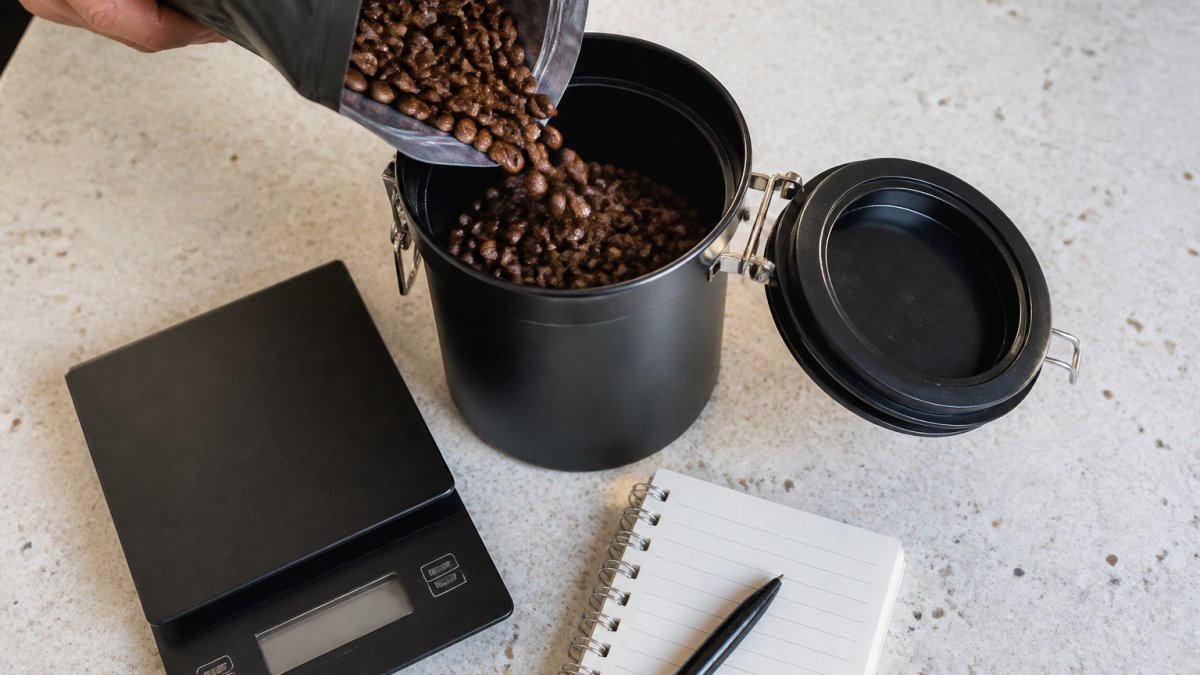
A few habits protect your investment:
- Buy amounts you'll finish within a few weeks
- Write the roast date on the container
- Keep the bag sealed between pours
That last point matters more than people think. Old beans carry stale oils that spread to fresh ones.
Step 3: Choose a Cool, Dark Place Away From Heat
Heat speeds up every chemical reaction that makes coffee go stale. Your storage spot should stay cool and steady.
Good spots:
- A closed pantry or cabinet
- A shelf away from the oven
- A corner away from direct sun
Bad spots:
- Above the stove
- Next to the dishwasher
- A windowsill
Room temperature is fine. The goal is steady, not cold. Big temperature swings cause condensation inside the container, and moisture ruins coffee fast.
Step 4: How to Store Ground Coffee Without Losing Flavor
Ground coffee stales much faster than whole beans because more surface meets the air. If you must store it ground, keep it in a small airtight container, fill it to the top to limit air, and use it within a week or two.
Better yet, grind just before brewing. A burr grinder takes seconds and makes a clear difference in the cup. If you buy pre-ground for convenience, buy smaller amounts more often.
Step 5: How Long Do Coffee Beans Stay Fresh?
There's no single shelf life for specialty coffee. Freshness depends on the roast date, how the beans were packaged, how they're stored, and how you brew them. Treating every bag the same is the fastest way to drink flat coffee.
Start With the Roast Date, Not a 'Best By' Label
Roast date is the only reliable freshness signal on a specialty bag. A 'best by' date tells you almost nothing, it's often set months out and has no relationship to when the coffee actually peaked. If a bag doesn't show a roast date, that's a red flag.
A practical framework:
- Days 1-3 after roast: Beans are degassing heavily. Espresso can be gassy and unstable; pour-over often tastes best after a short rest.
- Days 4-14: The sweet spot for most brewing methods. Aromatics are at their peak and the coffee is stable enough to extract evenly.
- Days 15-30: Flavor begins to flatten. Still enjoyable, especially in milk drinks or darker roasts.
These windows shift with roast level. Lighter roasts often need a few extra days to open up; darker roasts peak earlier and fade faster.
Degassing and the Valve
Freshly roasted beans release carbon dioxide for days after roasting. That's why quality bags have a one-way valve, it lets gas escape without letting oxygen in. If you transfer beans to a fully sealed container too soon, the trapped gas can make the coffee taste sharp or metallic. For beans within the first week or two of roasting, a valve bag or a container with a valve is the better choice.
Package Type Changes the Timeline
How the coffee arrived matters:
- Valve bag, unopened: Best-case scenario. The valve manages degassing and the bag blocks most light. Store it in a cool, dark cabinet and it holds well through the peak window.
- Valve bag, opened: Once opened, oxygen exposure begins in earnest. Reseal tightly after each use and plan to finish within two to three weeks.
- No valve, or a simple tin tie: Transfer to an airtight, opaque container. Without a valve, you're relying on the container to manage both gas and oxygen.
Freshness Indicators You Can See and Smell
Your senses are the most reliable tool you have:
- Smell: Fresh beans hit you with aroma the moment you open the bag. Stale beans smell flat or papery.
- Look: Fresh beans have a slight sheen from surface oils. Very old beans look dry and matte.
- Sound: Fresh beans crack softly when you bite one. Stale beans feel soft.
Match Storage to Your Brewing Routine
How fast you go through a bag should drive where you keep it:
- Daily brewer, one bag at a time: Countertop airtight container or the original valve bag in a cabinet is plenty.
- Weekend brewer or occasional espresso: Consider freezing half the bag in portions and keeping the rest on the counter.
- Stocking up on a favorite lot: Freeze in single-week portions and rotate as you brew.
Step 6: When and How to Freeze Specialty Coffee
Freezing is the single most misunderstood storage method in specialty coffee. Done poorly, it introduces moisture and stale flavors. Done well, it pauses the clock on a bag you won't finish within a few weeks, and it's the only method that meaningfully extends the drinking window past the roast date.
When Freezing Actually Makes Sense
Freeze when you have more coffee than you'll brew in about three weeks. That's the practical cutoff for whole beans stored at room temperature. If you bought a 12-ounce bag and pull two shots a day, you'll finish it in time, no freezer needed.
A common pattern among home brewers: keep one week's worth on the counter, freeze the rest in single-week portions, and rotate as you go.
Portion Before You Freeze, Not After
The most important rule is portioning. Freeze beans in amounts you'll use in about a week. Once a portion is thawed, it should not go back in the freezer.
A kitchen scale makes this easy. Weigh out portions that match your brewing routine, for example, enough for five to seven days of pour-over, or a set number of espresso doses.
Packaging That Limits Air and Moisture
Air and moisture are the two things you're fighting. Use packaging that minimizes both:
- Original valve bag, squeezed and sealed. If the bag has a one-way valve, press out excess air, reseal it, and place it inside a second airtight bag or container. The valve lets residual carbon dioxide escape without letting oxygen in.
- Vacuum-sealed portions. Removing air entirely slows oxidation. This is the most reliable option for long-term storage.
- Small airtight containers. Fill them to the top so there's minimal headspace. Empty space is just oxygen waiting to work on your beans.
Whichever you choose, keep portions small. A large container with a little coffee inside defeats the purpose.
The Thaw Protocol
How you thaw matters as much as how you freeze.
- Pull one portion at a time, never the whole stash.
- Let it come to room temperature before opening the package. Opening cold beans exposes them to condensation, and moisture is the enemy.
- Once thawed, open, grind, and brew. Don't leave the portion sitting out for hours.
A common pattern is to move tomorrow's portion from the freezer to the counter the night before, so it's ready when you are.
How Long Frozen Coffee Stays Good
Frozen whole beans hold their quality for several months when portioned and packaged well. Flavor does fade eventually, but the decline is far slower than at room temperature. The roast date on your label is still your best guide, a bag frozen a week after roasting will taste noticeably better than one frozen a month after.
Storage Method |
Best For |
Expected Freshness |
|---|---|---|
Airtight opaque canister, pantry |
Daily use, whole beans |
2-4 weeks |
Original valve bag, closed cabinet |
Short-term, unopened bags |
2-4 weeks |
Freezer, portioned airtight |
Long-term backup supply |
Several months |
Ground in small container |
Convenience brewing |
1-2 weeks |
Common Storage Mistakes to Avoid
Most storage problems trace back to a handful of habits.
- The refrigerator. Moisture and odors ruin coffee. Skip it.
- Clear jars in sunlight. Light degrades the oils. Use opaque or store in a cabinet.
- Big containers, little coffee. Empty space means more oxygen. Match container size to batch size.
Conclusion: Build a Storage Routine That Protects Every Batch
Great coffee is fragile. It starts fading the moment it leaves the roaster, and your storage choices decide how much of that peak flavor reaches your cup.
At Everything I Need, we roast to order from high-elevation estate beans, using precision thermal mapping to keep bitterness out and sweetness in. Our small-batch process delivers the cacao and hazelnut notes that make a morning worth waking up for.
Get started with Everything I Need and taste what properly stored, freshly roasted specialty coffee can do.
Frequently Asked Questions
Should specialty coffee be stored in an airtight container?
Yes. An airtight coffee storage container limits oxygen exposure, which is the main driver of oxidation and stale flavor. For specialty coffee, the container should also block light and fit in a cool, dark spot like a pantry or cabinet. If you keep beans in their original resealable bag, push out excess air and fold the top down before sealing. A dedicated opaque canister with a tight seal generally holds freshness longer than a thin bag alone.
Is it better to store coffee beans in the freezer or pantry?
For coffee you will finish within two to four weeks of the roast date, the pantry is simpler and avoids condensation risk. For longer storage, freezing whole beans in an airtight, opaque container works well if you portion out what you need and let the beans come to room temperature before grinding. Avoid moving the container in and out of the freezer repeatedly, because temperature swings introduce moisture that speeds up staling.
How long do coffee beans stay fresh after opening?
Whole beans typically hold peak flavor for about two to four weeks after the roast date when stored in an airtight, opaque container in a cool, dark place. After opening the package, that window starts ticking faster because oxygen and humidity have already entered the bag. Ground coffee loses aroma much sooner, often within days. Check the roast date, not just the best-by date, to judge how much time you have.
Can you store coffee in its original bag?
You can, but the results depend on the bag. A resealable bag with a one-way valve protects beans during degassing and works for short-term storage if you press out air and seal it tightly. Once the bag is opened and rolled shut, it lets in more oxygen than a rigid airtight container. For specialty coffee you plan to keep more than a week or two, transfer the beans to an opaque airtight container and keep the bag for reference on the roast date.