

How Altitude Shapes Artisan Coffee Flavor
Table of Contents
- The Impact of Altitude on Artisan Coffee Flavor
- High-Altitude Coffee Flavor: What the Elevation Does
- Coffee Bean Density and Altitude
- How Altitude Affects Coffee Roasting
- Factors That Affect Coffee Flavor Beyond Elevation
- Reading Altitude on Coffee Labels and Tasting Notes
- Frequently Asked Questions
Last Updated: October 10, 2026
The Impact of Altitude on Artisan Coffee Flavor
Altitude shapes coffee flavor profoundly by determining ripening speed, bean density, and the notes that emerge in your cup. Understanding why high-altitude coffee flavor profiles differ from lowland varieties matters if you're serious about specialty coffee.

At Everything I Need, we source beans exclusively from high-elevation estates because cooler temperatures slow ripening, allowing sugars and flavor precursors to accumulate in ways that don't happen at sea level.
Elevation works alongside species selection, processing methods, and roasting technique to create the final cup profile. Understanding how altitude shapes the bean itself reveals why certain origins taste the way they do.
High-Altitude Coffee Flavor: What the Elevation Does
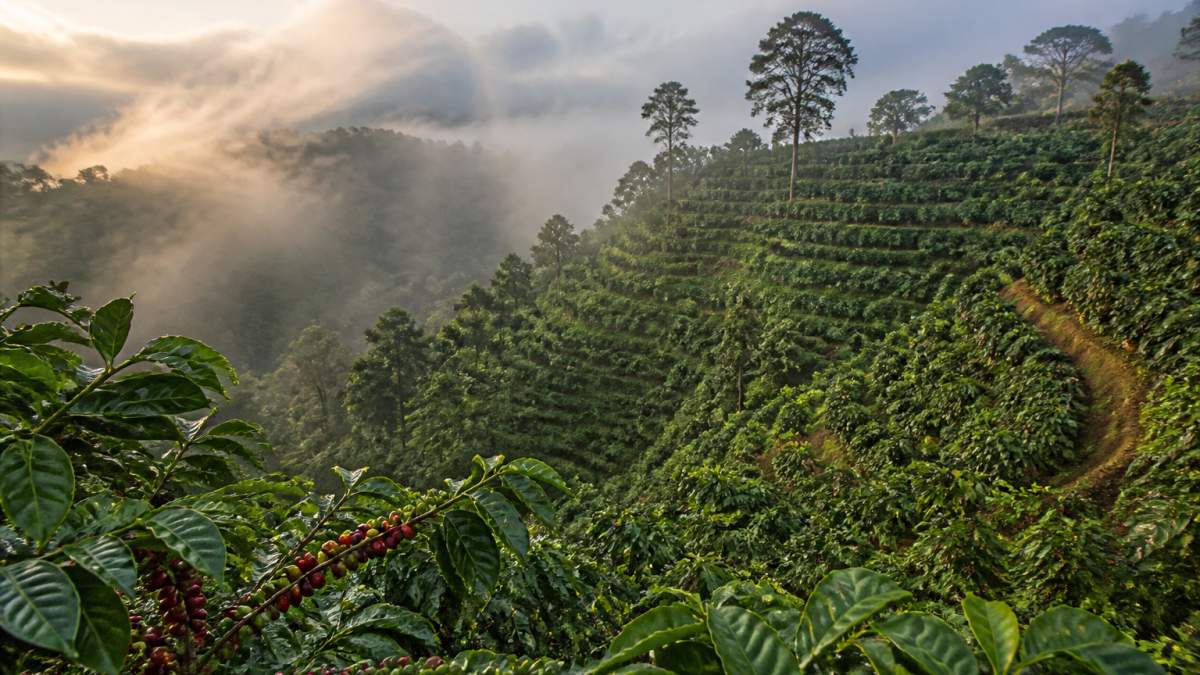
High-altitude coffee flavor develops distinctly because beans cultivated above 4,000 feet experience cooler temperatures that slow cherry maturation, allowing greater complexity and sweetness to develop.
Cooler Temperatures and Slower Ripening
Cooler temperatures slow cherry ripening, giving the plant more time to convert starches into sugars and develop aromatic compounds that become the notes you taste after roasting.
Low-altitude coffee ripens quickly under intense heat, producing flatter flavor profiles with less complexity and sweetness. This is why commodity coffee from lower elevations tends toward bitterness and simplicity.
Daily temperature swings at high altitude trigger defensive chemistry that concentrates flavor compounds in the bean, similar to how cooler climates produce more complex wines.
Brightness, Acidity, and Complexity
High-altitude coffee flavor typically shows brighter acidity and greater complexity than lowland varieties. This brightness means liveliness and clarity, desirable signs that the bean developed properly.
Altitude coffee flavor tends toward greater sweetness and layered notes. Where a low-altitude bean might taste like chocolate and nuts, a high-altitude equivalent reveals citrus, floral notes, and caramel undertones.
Acidity correlates directly with altitude: higher elevations produce brighter beans, lower elevations produce softer acidity and heavier body. If you prefer cleaner, brighter cups, altitude coffee flavor profiles from higher elevations typically suit your palate better.
Coffee Bean Density and Altitude
Bean density increases with altitude, affecting how coffee behaves during roasting and brewing. High-altitude beans are harder and denser, influencing extraction and flavor development.
Dense beans require longer roasting times, allowing more complete flavor development. A dense bean from high elevation can tolerate roasting approaches that would char a softer, lower-altitude bean.
Density also affects brewing: dense beans require hotter water and longer contact time. Altitude coffee flavor can seem muted with brewing parameters designed for lower-altitude beans; adjust your method to match the bean's density.
Bean hardness correlates with altitude and signals quality, it suggests the bean developed fully and accumulated compounds that create interesting flavor.
How Altitude Affects Coffee Roasting
Roasting high-altitude beans requires different timing and temperature curves than lowland coffee. The density of altitude coffee means heat penetrates more slowly; roasters must account for this or risk under-developing or over-charring the bean.
At Everything I Need, we use precision thermal mapping to match heat application to the bean's density. High-altitude beans from our estates respond to slower, controlled roasting that brings out sweetness and eliminates bitterness.
Roast level interacts with altitude coffee flavor distinctly. Light roast preserves brightness and acidity; medium roast balances sweetness with origin character; dark roast develops chocolate and caramel notes without becoming ashy or bitter, harder to achieve with lower-altitude beans.
Roast quality matters as much as bean sourcing: a poorly roasted high-altitude bean loses its advantage, while a well-roasted one becomes genuinely special.
Factors That Affect Coffee Flavor Beyond Elevation
Altitude coffee flavor operates within a complex system: cultivar, latitude, soil composition, shade coverage, rainfall, processing method, and farm management all shape flavor alongside elevation. Understanding these interactions is essential to interpreting altitude information on labels.
Why Altitude Claims Can Be Misleading
A common mistake is treating altitude as a flavor guarantee. Two farms at identical elevations can produce dramatically different flavors due to differences in soil, shade, and processing method.
Latitude matters as much as elevation. A farm at 4,000 feet near the equator experiences different temperature patterns than a farm at 4,000 feet at 20 degrees north latitude, affecting ripening rates and flavor development.
Soil type influences how plants respond to altitude. Volcanic soils retain moisture and nutrients differently than clay or sandy soils, creating different mineral notes and sweetness in the final bean.
Shade coverage and agroforestry practices interact with altitude, affecting ripening rates and complexity independent of elevation.
Species: Arabica Versus Robusta
Arabica and Robusta respond differently to altitude, and this difference is fundamental to understanding elevation's role in flavor.
Arabica thrives at higher elevations (typically 2,000-6,500 feet) and develops the complex, nuanced flavors specialty roasters pursue. The species requires cooler conditions (roughly 60-70°F) to develop properly, creating the acidity, sweetness, and aromatic complexity that define specialty coffee.
Robusta grows better at lower elevations and warmer temperatures (70-85°F), producing beans with higher caffeine, earthier flavors, and heavier body. Robusta doesn't develop the same complexity as Arabica because the species' chemistry is fundamentally different. If you prefer brighter, more complex cups, seek Arabica from high elevations.
Most specialty coffee comes from Arabica. When you buy altitude coffee flavor from a specialty roaster, you're almost certainly buying Arabica.
Processing and Post-Harvest Methods
How coffee is processed after harvest affects flavor as much as growing conditions do, and processing can amplify or obscure altitude-associated characteristics.
Washed processing removes fruit mucilage before drying, emphasizing clarity, brightness, and the bean's inherent acidity. A high-altitude Arabica processed washed will show pronounced brightness and complexity.
Natural processing dries the entire cherry in the sun, creating fruity, wine-like characteristics and heavier body. A high-altitude bean processed naturally will show different character than the same bean washed, with fruit-forward sweetness replacing some altitude-driven brightness.
Honey processing removes the skin but retains some or all of the fruit mucilage during drying, balancing sweetness with acidity. The amount of mucilage retained creates a spectrum of flavor outcomes from the same beans.
Fermentation time, drying method, and storage conditions also influence final flavor. These post-harvest variables can enhance or diminish the advantages of high-altitude sourcing, which is why sourcing from estates with rigorous protocols matters, altitude alone doesn't guarantee quality.
Isolating Altitude's Actual Influence
To understand what altitude contributes to a cup, look for beans that differ primarily in elevation while holding other variables constant. When you find two beans from the same origin, same cultivar, and same processing method but different elevations, you're seeing altitude's isolated effect.
In practice, this is rare. Most single-origin coffees vary in multiple ways simultaneously. Understanding the principle helps you read labels critically: if a label lists only elevation without mentioning cultivar, processing, or soil, you're missing context that shapes flavor as much as altitude.
Reading Altitude on Coffee Labels and Tasting Notes
Altitude information on labels tells you something concrete about what to expect, but only if you understand how elevation thresholds vary by region.
Altitude Ranges and Regional Thresholds
Altitude is typically listed in meters or feet on specialty coffee labels.
In Central America, high-altitude coffee typically means above 4,000 feet. Beans from Guatemala, Honduras, and Costa Rica above this threshold show brightness and complexity; above 5,000 feet often indicates exceptional complexity and floral notes.
In East Africa (Ethiopia, Kenya, Uganda), high-altitude coffee starts around 4,500-5,000 feet because equatorial latitude means cooler baseline temperatures.

In South America (Peru, Colombia, Brazil), high-altitude coffee begins around 3,500-4,000 feet in the Andes, where elevation gain creates steep temperature gradients. Colombian coffees from 4,500-6,000 feet are considered high altitude.
In Southeast Asia (Indonesia, Papua New Guinea), high-altitude coffee starts around 3,500 feet because of equatorial location and volcanic soil characteristics.
The takeaway: when you see an elevation number on a label, compare it to the origin's typical range, not to a universal threshold. A 4,000-foot Ethiopian coffee is high altitude; a 4,000-foot Brazilian coffee is moderate.
Measurement Conventions and Label Interpretation
Most specialty roasters list elevation in meters or feet. Some list a single number ("5,200 feet"); others list a range ("4,500-5,500 feet") to account for variation across the farm. A range is more honest because elevation varies across a hillside, and different microclimates within a farm can produce slightly different flavor.
When a label lists elevation without specifying whether it's meters or feet, assume feet if the number is above 1,000 (e.g., "4,200" = 4,200 feet). If the number is below 1,000, it's likely meters (e.g., "1,200" = 1,200 meters, roughly 3,900 feet).
Some labels list elevation as "masl" (meters above sea level), which removes ambiguity. If you see "1,800 masl," that's 1,800 meters, or roughly 5,900 feet.
Higher elevation numbers generally predict brighter acidity and greater complexity, but the relationship isn't linear. The difference between 4,000 and 4,500 feet is meaningful; the difference between 5,500 and 6,000 feet may be subtle. And as noted above, the origin context matters more than the absolute number.
Tasting Notes as Elevation Clues
Tasting notes on labels give you clues about how altitude coffee flavor expresses in that particular bean, though they reflect processing and roast as much as elevation.
Notes associated with high-altitude coffee include: citrus (lemon, grapefruit, lime), floral (jasmine, rose, hibiscus), stone fruit (peach, apricot), bright, crisp, complex, tea-like, and pronounced sweetness. If you see these descriptors, the bean likely comes from higher elevation and/or washed processing.
Notes associated with lower-altitude coffee include: chocolate, cocoa, earthy, nutty, heavy body, syrupy, and straightforward. These suggest lower elevation and/or natural processing.
But processing method influences these notes as much as elevation does. A high-altitude natural-processed coffee might show fruity, wine-like notes (from the processing) rather than the brightness you'd expect from elevation alone.
The origin also matters. Peruvian high-altitude coffee often shows honey, caramel, and silky texture. Papua New Guinea high-altitude coffee tends toward earthy, herbal, and fruity notes. Ethiopian high-altitude coffee emphasizes floral and berry character. These regional flavor signatures overlay the altitude effect.
Using Altitude Information Practically
When you're tasting specialty coffee, pay attention to acidity and sweetness as primary signals. Brighter acidity and pronounced sweetness suggest high elevation. Softer acidity and heavier body suggest lower elevation. Over time, you'll develop intuition for reading these signals.
But don't treat altitude as a guarantee. A high-altitude bean poorly roasted will lose its advantage. A well-roasted lower-altitude bean from a quality estate may outperform a poorly handled high-altitude bean. Elevation is one input into a complex system.
When comparing two beans from the same origin, elevation differences are meaningful. A Peruvian coffee at 5,500 feet will typically show more brightness and complexity than a Peruvian coffee at 3,500 feet, all else equal. When comparing beans from different origins, elevation alone tells you less; you need to account for latitude, processing, and roast.
If you prefer complexity, brightness, and nuanced sweetness, seek beans labeled with higher elevations (above 4,500 feet for most origins, adjusted for regional thresholds). If you prefer straightforward, heavy-bodied coffee, lower elevations may suit you better.
Frequently Asked Questions
Does coffee grown at higher altitudes taste better?
Higher elevation often produces coffee with brighter acidity, greater complexity, and more nuanced flavor notes compared to lower-elevation beans. However, 'better' depends on your preferences. Some coffee drinkers prefer the bold earthiness of low-altitude coffee, while others seek the floral and citrus characteristics typical of high-altitude coffee. The altitude alone doesn't guarantee quality—processing method, bean variety, and roasting technique matter equally.
How does altitude affect coffee bean density and how you brew it?
Higher altitudes produce denser, harder beans because cooler temperatures slow cherry ripening and allow sugars to concentrate. Dense beans require more heat and longer extraction times to release their full flavor. When brewing high-altitude coffee, use slightly hotter water and extend your brew time by 10-15 seconds compared to lower-elevation beans. This ensures you're extracting the complex sweetness and avoiding under-extraction, which can taste sour or thin.
What flavor notes are common in high-altitude coffee?
High-altitude coffee typically displays bright, fruity, and floral characteristics: citrus (lemon, orange), green apple, berries, jasmine, and honey. You may also encounter chocolate, caramel, or nutty undertones depending on the origin and roast level. Low-altitude coffee tends toward earthier, heavier notes like cocoa, leather, and spice. These flavor differences stem from the slower ripening process at elevation, which develops more complex sugar compounds and aroma precursors.
What factors besides altitude affect how coffee tastes?
Coffee flavor depends on bean variety (Arabica versus Robusta), soil composition, rainfall patterns, processing method (washed, natural, honey), and roasting profile. Processing especially influences taste—natural-processed beans develop fruitier, sweeter notes, while washed beans emphasize origin characteristics and acidity. Roast level also reshapes flavor: light roasts preserve origin complexity, while darker roasts introduce roasted and caramelized notes that can mask altitude-driven characteristics.