

Which Manual Coffee Grinder Is Right for Your Brewing Style?
Last Updated: October 24, 2026
Quick Summary
A manual coffee grinder is a hand-powered device that breaks coffee beans into consistent particles without electricity, giving you direct control over grinding speed and pressure. Manual grinders excel for pour-over and French press brewing by producing uniform grinds that extract evenly, though they struggle with espresso's demanding fine-grind requirements.
- Burr grinders produce more uniform particles than blade grinders because burrs crush beans between two surfaces rather than chopping randomly.
- Pour-over demands a medium-fine, uniform grind; manual grinders work well because most quality models adjust in small increments and provide tactile feedback.
- French press benefits from manual grinders because coarse grinds are easier to produce uniformly, and quality burrs produce fewer fines that slip through the metal mesh filter.
- Most manual grinders struggle at fine espresso settings, producing powdery spots and chunks that cause channeling, making an electric burr grinder more practical for espresso.
- Replacement burr availability and price determine long-term value; a grinder offering $30-$50 burr replacements beats a sealed unit that must be discarded when burrs dull.
Table of Contents
- What Makes a Manual Coffee Grinder Worth Using
- Grind Consistency and Particle Uniformity: The Foundation of Flavor
- Manual Coffee Grinder for Pour-Over: Precision Without Compromise
- Manual Coffee Grinder for French Press: Coarse, Consistent Results
- Manual Coffee Grinder for Espresso: The Challenge and the Reality
- Best Budget Manual Coffee Grinder: Balancing Cost and Performance
- Durability, Maintenance, and Long-Term Value
- Selecting Your Manual Grinder: Key Criteria and Common Mistakes
- Frequently Asked Questions
What Makes a Manual Coffee Grinder Worth Using
A manual coffee grinder is a hand-powered device that breaks coffee beans into consistent particles without electricity, giving you direct control over grinding speed and pressure.
The real advantage is grinding consistency. Uniform particles extract evenly; an uneven grind yields bitter, over-extracted fines alongside sour, under-extracted boulders in the same cup.
Manual grinders also eliminate the heat buildup that some electric burr grinders create, which can damage delicate aromatics in premium beans. For those sourcing high-elevation estate beans, that preservation matters.
Grind Consistency and Particle Uniformity: The Foundation of Flavor
Grind consistency refers to how similar each particle is in size, uniformity separates a smooth extraction from a muddy, unbalanced one.
Uniform particles extract at the same pace. Uneven grinds create "fines" that over-extract and "boulders" that under-extract, producing bitterness competing with sourness.
Burr grinders (conical or flat) produce more uniform particles than blade grinders because burrs crush beans between two surfaces rather than chopping randomly. Burr material, sharpness, and alignment determine consistency.
A practical test: grind a small sample and inspect it under bright light. Quality grinders produce similarly sized particles; budget models show obvious variation.
Manual Coffee Grinder for Pour-Over: Precision Without Compromise
Pour-over demands precision: water flows through the grounds in seconds, so a medium-fine, remarkably uniform grind, finer than drip, coarser than espresso, matters.
A manual grinder works well for pour-over because most quality models adjust from coarse to fine in small increments, essential when dialing in a new bean.
Hand-grinding also gives tactile feedback: you feel the resistance as beans break down, helping you stay consistent from batch to batch.
For those exploring pour-over methods, French Press vs AeroPress: Beginner Comparison Guide and Is Pour Over Coffee Worth the Effort? A 2026 Review can help you confirm whether pour-over aligns with your brewing goals before investing in a grinder optimized for it. Additionally, Pour Over vs French Press: Taste Difference Guide clarifies how grind differences between methods affect your choice.
Manual Coffee Grinder for French Press: Coarse, Consistent Results
French press grounds steep for several minutes, so under-extraction is less of a problem, but over-extraction produces a bitter, muddy cup quickly.
The solution is a coarse grind. A manual grinder excels here because coarse grinds are easier to produce uniformly, the margin for error is wider.
The challenge with French press is sediment: fine particles slip through the metal mesh filter into your cup.
If some particles are coarse and others powder, the powder over-extracts while the coarse under-extract, yielding a murky cup.
Manual Coffee Grinder for Espresso: The Challenge and the Reality
Espresso is where manual grinders show their limits. It demands an extremely fine, uniform grind, and water forces through in 25-30 seconds under high pressure, so every particle size matters.
Most manual grinders can grind fine enough for espresso, but the effort becomes substantial, meditative for some, exhausting before the first cup for others.
The bigger issue is uniformity: many manual grinders struggle at fine settings, turning powdery in spots and chunky in others, causing channeling, water finds paths of least resistance, over-extracting some areas and under-extracting others.
If espresso is your primary brewing method, an electric burr grinder is the more practical choice. For those interested in espresso techniques, How to Get Thick Crema on Home Espresso: 2026 Guide covers specific methods that depend on grind consistency.
Best Budget Manual Coffee Grinder: Balancing Cost and Performance
A budget manual grinder doesn't mean poor quality, it means prioritizing essentials. To choose well, you need a repeatable way to compare them, not just a list of specs.
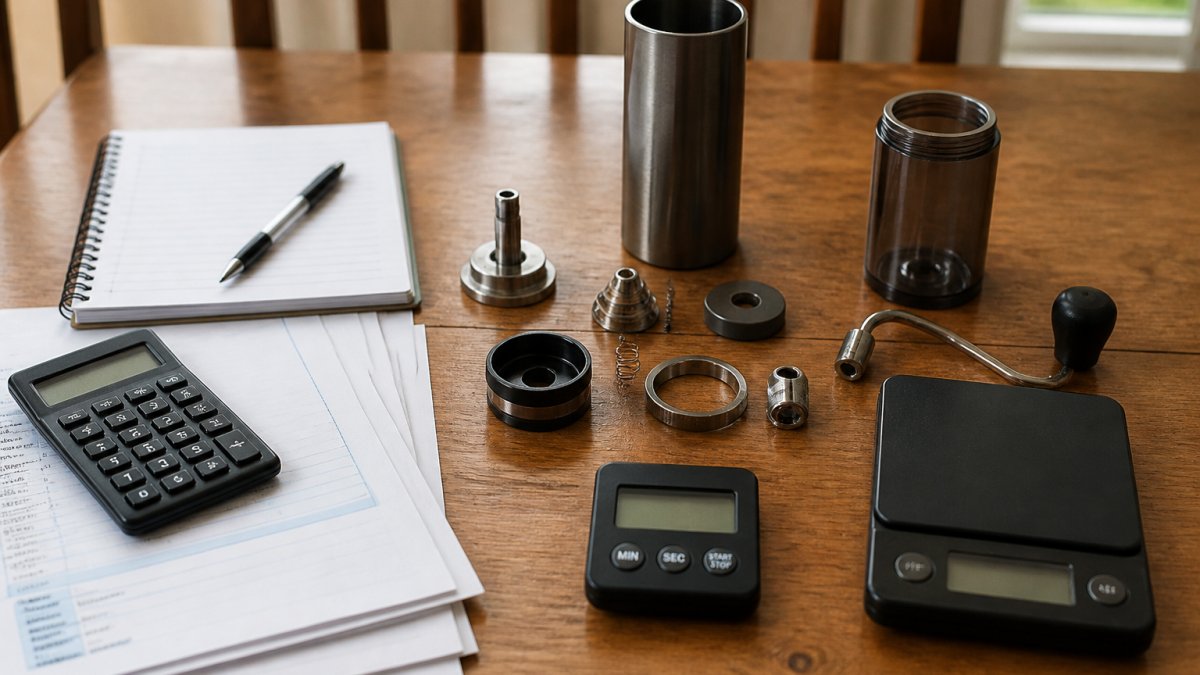
A Simple Testing Methodology You Can Replicate
Here's a consistent method you can use at home to compare budget grinders on the factors that affect your cup:
- Grind consistency: Grind a 15 g dose at a medium setting. Spread the grounds on a white plate under bright light. Look for the ratio of fines (dust-like particles) to boulders (large chunks). A good budget grinder shows mostly uniform particles with minimal extremes.
- Speed and effort: Time how long it takes to grind 15 g at a medium-fine setting. Note the number of revolutions and how much force you need to apply. Most budget hand grinders take 60-120 seconds for a pour-over dose; anything beyond that signals a dull burr or poor ergonomics.
- Retention and static: Weigh the beans before and after grinding. The difference is retention, grounds left inside the grinder. Static can cause grounds to cling to the catch cup and hopper. A light spritz of water on beans before grinding (the "Ross droplet" technique) can reduce static, but budget grinders with plastic catch cups often retain more than metal ones.
- Build and alignment: Check for wobble in the handle and shaft. A wobbly shaft causes burr misalignment and inconsistent grinds. Grip the handle and turn slowly; any side-to-side play is a red flag.
What Budget Grinders Do Well, and Where They Cut Corners
Budget manual grinders typically use conical burrs of ceramic or coated steel.
Capacity matters less than consistency: a 25-30 g hopper suits one or two cups, and a metal catch cup reduces static and retention compared to plastic.
Handle ergonomics matter, you'll grip it for minutes at a time, and a thin or poorly balanced handle becomes tiring. Check weight distribution and grip comfort before buying.
The Total Cost of Ownership Angle
A budget grinder's sticker price is only part of the story. Many models don't sell burrs separately, making the grinder disposable when burrs dull.
Warranty terms also matter: budget grinders often carry one year, some premium budget models two or three. Read the fine print, burr wear is usually excluded.
The practical trade-off: budget manual grinders produce good grind consistency for pour-over and French press but struggle with espresso and high-volume grinding.
Durability, Maintenance, and Long-Term Value
A manual grinder is mechanically simple, so it's durable if built well, but durability also means whether you can get replacement parts and what the grinder costs over its lifespan.
Wear, Repairability, and Replacement Parts
Burrs are the wear item. Steel burrs last hundreds of pounds of coffee before dulling; ceramic burrs can chip or wear faster. Dull burrs hurt consistency, more fines and boulders, and longer grinding.
The key question is whether the manufacturer sells replacement burrs. Many quality manual grinders offer burr sets separately, restoring performance for a fraction of a new grinder's cost.
Other wear points include the handle joint and the adjustment mechanism. A wobbling handle or slipping adjustment dial indicates wear.
Warranty and Serviceability
Warranty terms vary widely. Budget grinders often carry a one-year warranty; premium manual grinders may offer two, three, or even a limited lifetime warranty. Read the fine print, most exclude burr wear as normal wear and tear.
Serviceability matters too. Can you disassemble the grinder to clean or replace burrs with common tools? A grinder requiring proprietary tools or glued together is harder to maintain. Look for removable burr sets and clear disassembly instructions.
Cleaning and Maintenance Routine
Maintenance is straightforward. After each use, empty the hopper and wipe out residual grounds. Once a month, disassemble and clean the burrs with a dry brush; removable burr sets make this easier. Avoid washing burrs with water, moisture rusts steel and degrades ceramic. A dry brush and cloth are sufficient.
The Real Cost of Ownership
The real cost of ownership includes physical effort. Manual grinding takes 1-3 minutes depending on grind fineness and bean volume, 7-21 minutes per week if you grind daily. For some that's part of the appeal; for others, a dealbreaker. Factor it into your decision.
Beyond effort, consider total cost: purchase price plus replacement burrs over the grinder's life. A $50 grinder with no replacement burrs might last two years; a $100 grinder with $40 burr sets every five years could last a decade or more.
Selecting Your Manual Grinder: Key Criteria and Common Mistakes
When choosing a manual grinder, focus on burr type, adjustment range, and build quality.
Burr type determines grind uniformity.
Adjustment range matters if you brew multiple ways: pour-over needs medium-fine settings, French press needs coarse. Check that the adjustment dial covers the range you need.
Build quality shows in the handle, hopper, and burr alignment. A wobbly handle or misaligned burrs produce inconsistent grinds. Feel the grinder in your hand if possible.
A practical comparison:
Criterion |
Priority |
What to Look For |
|---|---|---|
Burr type |
High |
Conical or flat burrs; avoid blade grinders |
Adjustment range |
High |
Covers your brewing methods (coarse to fine) |
Build quality |
High |
Solid handle, no wobble, burrs aligned |
Capacity |
Medium |
30-50g hopper is typical; size depends on use |
Ease of cleaning |
Medium |
Removable burr set or accessible design |
Grinding effort |
Low |
Varies by model; test if possible |
Selecting the right manual grinder depends on how you brew and what you value. A manual grinder gives you that control, letting you dial in the grind that brings out the complex sweetness and rich notes in every cup. Fix Common Coffee Brewing Mistakes: A Troubleshooting Guide can help you troubleshoot extraction issues as you dial in your technique.
Frequently Asked Questions
How do I choose the right manual coffee grinder for my brewing method?
Start with your brew method. Pour-over and drip coffee need medium-fine, uniform particles; French press requires a coarse grind; espresso demands precision and very fine consistency. Check the grinder's adjustment range to confirm it covers your target size. Then consider capacity (how many cups you brew daily), burr type (conical burrs handle coarser settings better; flat burrs excel at fine, espresso-ready grinds), and your tolerance for grinding effort and time. A grinder that adjusts smoothly and produces consistent particle size will reduce the trial-and-error phase when dialing in your brew.
What's the difference between conical burr and flat burr grinders?
Conical burrs (cone-shaped) are gentler on beans, produce less heat, and work well for medium and coarse grinds like French press and cold brew. Flat burrs (two parallel discs) deliver more uniform, finer particles and are the preference for espresso and pour-over, though they generate slightly more heat and require more grinding force. For home brewing across multiple methods, conical burrs offer versatility and easier operation. For espresso or precision pour-over, flat burrs give you the consistency extraction demands.
Can a manual coffee grinder produce espresso-fine grounds?
Technically yes, but with caveats. Manual espresso grinders exist, but they require significant physical effort and time—often 5-10 minutes per shot. The fine, uniform particles espresso extraction needs are achievable only with grinders specifically designed for that fineness and with flat burrs. Most general-purpose manual grinders cannot reach the consistency espresso requires. If espresso is your primary brew method, a manual grinder is impractical; consider whether a manual grinder for pour-over or French press better fits your actual daily routine.
How long does it take to grind coffee by hand?
For a single cup (about 15-20 grams of beans), expect 1-3 minutes with a quality manual grinder, depending on burr type, grind size, and your physical effort. Coarser grinds (French press) are faster; finer grinds (pour-over) take longer. Conical burr grinders are typically faster than flat burr models. The ritual and control many coffee enthusiasts enjoy offset the time investment, especially for morning routines. If you brew multiple cups daily, grinding time becomes a real factor—consider your schedule before committing to manual grinding.
